Ch. 36 - The Special Theory of Relativity
Giancoli Douglas - Physics for Scientists and Engineers 5th edition
Giancoli Douglas5th editionPhysics for Scientists and EngineersISBN: 9780137488179당신이 사용하는 게 아니라요?교과서 변경
35장, 문제 61

A certain galaxy has a Doppler shift given by ƒ₀ - ƒ = 0.1015 ƒ₀. Estimate how fast it is moving away from us.

검증된 단계별 안내
1
Understand the Doppler effect: The Doppler shift formula for light is given by \( \frac{\Delta f}{f_0} = \frac{v}{c} \), where \( \Delta f = f_0 - f \) is the change in frequency, \( f_0 \) is the original frequency, \( v \) is the velocity of the galaxy relative to the observer, and \( c \) is the speed of light.
Identify the given values: From the problem, \( f_0 - f = 0.1015 f_0 \). This means \( \Delta f = 0.1015 f_0 \).
Substitute \( \Delta f \) into the Doppler shift formula: \( \frac{\Delta f}{f_0} = \frac{v}{c} \). Using \( \Delta f = 0.1015 f_0 \), the equation becomes \( \frac{0.1015 f_0}{f_0} = \frac{v}{c} \).
Simplify the equation: The \( f_0 \) terms cancel out, leaving \( 0.1015 = \frac{v}{c} \).
Solve for \( v \): Multiply both sides by \( c \) to isolate \( v \), giving \( v = 0.1015 c \). This is the velocity of the galaxy moving away from us.

비슷한 문제에 대한 검증된 영상 답변:

이 영상 해법은 위 문제에 도움이 된다고 튜터들이 추천한 것입니다.
영상 길이:
3m
도움이 되었나요?

주요 개념

질문에 올바르게 답하기 위해 반드시 이해해야 하는 핵심 개념들은 다음과 같습니다.

Doppler Effect

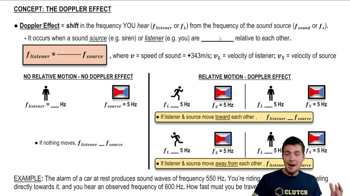
The Doppler Effect refers to the change in frequency or wavelength of a wave in relation to an observer moving relative to the source of the wave. In astronomy, it is commonly observed in the light from stars and galaxies, where a shift towards longer wavelengths (redshift) indicates that an object is moving away from the observer.
추천 영상:
가이드 코스
07:40
The Doppler Effect

Redshift

Redshift is a phenomenon where light from an object is shifted to longer wavelengths, typically observed in the light from galaxies moving away from Earth. It is quantified as the ratio of the change in frequency to the original frequency, and it provides critical information about the velocity of the object relative to the observer.

Velocity Calculation

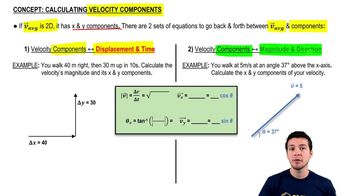
Velocity calculation in the context of the Doppler shift involves using the observed shift in frequency to determine how fast an object is moving away. The formula relates the observed frequency shift to the speed of light and the original frequency, allowing astronomers to estimate the recession velocity of distant galaxies.
추천 영상:
가이드 코스
05:53
Calculating Velocity Components
관련 실천
교과서 질문

An atomic clock is taken to the North Pole, while another stays at the Equator. How far will they be out of synchronization after 1.5 years has elapsed? [Hint: Use the binomial expansion, Appendix A–2.]

1018
views

교과서 질문

(III) (a) In reference frame S, a particle has momentum p=pxi\(\overrightarrow{\mathbf{p}\)}=p_{x}\(\mathbf{i}\) along the positive x axis. Show that in frame S’, which moves with speed v as in Fig. 36–12, the momentum has components

px=pxvE/c21v2/c2p_{x}^{\(\prime\)}=\(\frac{px-vE/c^2}{\sqrt{1-v^2/c^2}\)}

py=pyp_{y}^{\(\prime\)}=py

pz=pzp_{z}^{\(\prime\)}=pz

E=Epxv1v2/c2.E^{\(\prime\)}=\(\frac{E-p_{x}\)v}{\(\sqrt{1-v^2/c^2}\)}.

(These transformation equations hold, actually, for any direction of p\(\overrightarrow{\mathbf{p}\)}, as long as the motion of S' is along the x axis.) (b) Show that px, py, pz, E/c transform according to the Lorentz transformation in the same way as x, y, z, ct.

797
views
교과서 질문

Make a graph of the kinetic energy versus momentum for (a) a particle of nonzero mass, and (b) a particle with zero mass.

1054
views
교과서 질문

A spaceship moving toward Earth at 0.65c transmits radio signals at 95.0 MHz. At what frequency should Earth receivers be tuned?

1253
views
교과서 질문

An electron (m = 9.11 x 10⁻³¹ kg) is accelerated from rest to speed v by a conservative force. In this process, its potential energy decreases by 7.20 x 10⁻¹⁴ J . Determine the electron’s speed, v.

1110
views
교과서 질문

Show that the kinetic energy K of a particle of mass m is related to its momentum p by the equation p=K2+2Kmc2cp=\(\frac{\sqrt{K^2+2Kmc^2}\)}{c}.

1115
views