
Ch. 36 - The Special Theory of Relativity
Giancoli Douglas - Physics for Scientists and Engineers 5th edition
Giancoli Douglas5th editionPhysics for Scientists and EngineersISBN: 9780137488179당신이 사용하는 게 아니라요?교과서 변경
35장, 문제 22

Two spaceships leave Earth in opposite directions, each with a speed of 0.50c with respect to Earth.
(a) What is the velocity of spaceship 1 relative to spaceship 2?
(b) What is the velocity of spaceship 2 relative to spaceship 1?

검증된 단계별 안내
1
Understand the problem: Two spaceships are moving in opposite directions relative to Earth, each with a speed of 0.50c (where c is the speed of light). We need to calculate the relative velocity of one spaceship as observed from the other. This involves using the relativistic velocity addition formula.
Recall the relativistic velocity addition formula: \( v_{rel} = \frac{v_1 + v_2}{1 + \frac{v_1 v_2}{c^2}} \), where \( v_1 \) and \( v_2 \) are the velocities of the two objects relative to a common reference frame (Earth in this case), and \( c \) is the speed of light.
Assign values: For spaceship 1, \( v_1 = 0.50c \) (relative to Earth). For spaceship 2, \( v_2 = -0.50c \) (negative because it is moving in the opposite direction relative to Earth). Substitute these values into the formula.
Substitute into the formula: \( v_{rel} = \frac{0.50c + (-0.50c)}{1 + \frac{(0.50c)(-0.50c)}{c^2}} \). Simplify the numerator and denominator step by step to find the relative velocity.
Interpret the result: The relative velocity \( v_{rel} \) will be the velocity of spaceship 1 as seen from spaceship 2. By symmetry, the velocity of spaceship 2 as seen from spaceship 1 will have the same magnitude but opposite direction. This is consistent with the principle of relativity.

비슷한 문제에 대한 검증된 영상 답변:

이 영상 해법은 위 문제에 도움이 된다고 튜터들이 추천한 것입니다.
영상 길이:
9m

주요 개념

질문에 올바르게 답하기 위해 반드시 이해해야 하는 핵심 개념들은 다음과 같습니다.

Relativity of Velocity

In the framework of special relativity, the velocity of an object is not absolute but depends on the observer's frame of reference. When two objects are moving at significant fractions of the speed of light (denoted as 'c'), their relative velocities must be calculated using the relativistic velocity addition formula, which accounts for the effects of time dilation and length contraction.
추천 영상:
가이드 코스
04:27
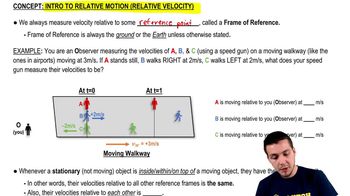
Intro to Relative Motion (Relative Velocity)

Relativistic Velocity Addition Formula

The relativistic velocity addition formula is used to determine the relative velocity of two objects moving at high speeds. It is expressed as v' = (u + v) / (1 + (uv/c²)), where u and v are the velocities of the two objects, and v' is the resultant velocity. This formula ensures that the resultant velocity does not exceed the speed of light, adhering to the principles of special relativity.
추천 영상:
가이드 코스
05:35
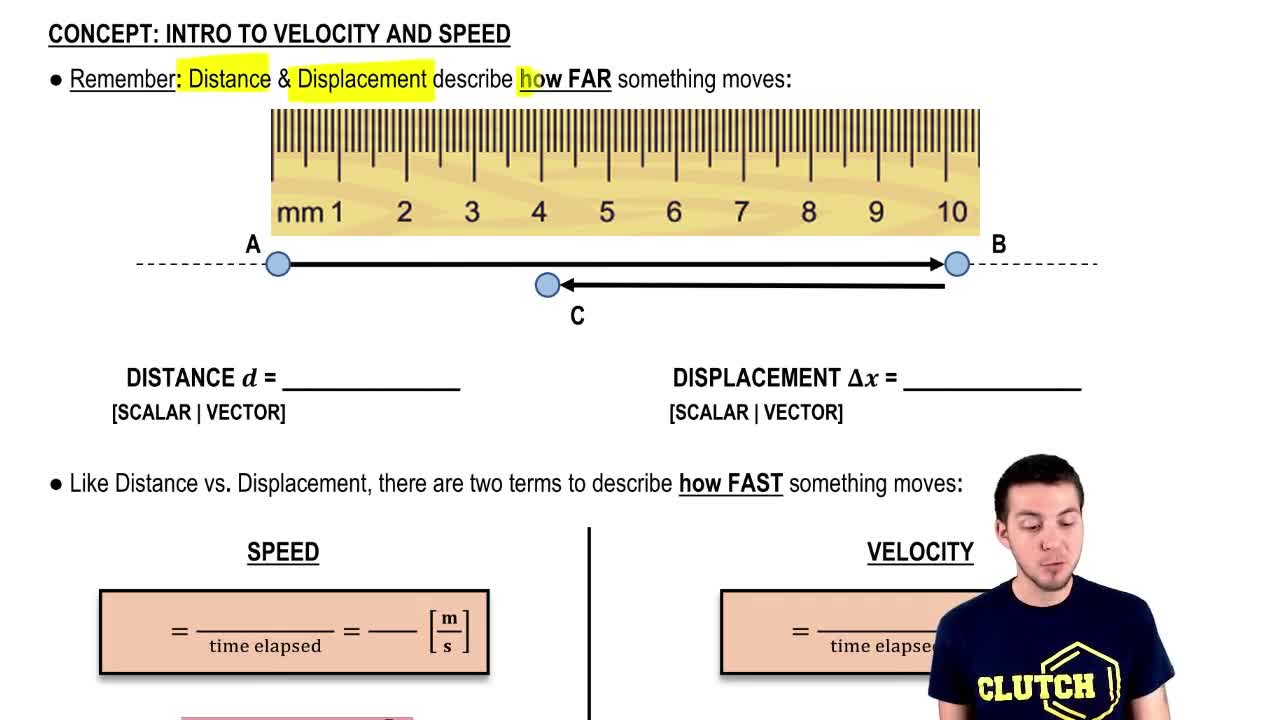
Intro to Velocity and Speed

Speed of Light (c)

The speed of light in a vacuum, denoted as 'c', is a fundamental constant in physics, approximately equal to 3.00 x 10^8 meters per second. It serves as the ultimate speed limit in the universe, meaning no object with mass can reach or exceed this speed. In relativistic physics, the speed of light plays a crucial role in defining the relationship between space and time, influencing how velocities are perceived and calculated.
추천 영상:
가이드 코스
06:03
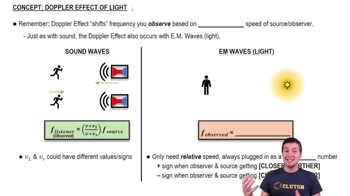
The Doppler Effect (Light)
관련 실천
교과서 질문

(I) An observer on Earth sees an alien vessel approach at a speed of 0.70c. The fictional starship Enterprise comes to the rescue (Fig. 36–17), overtaking the aliens while moving directly toward Earth at a speed of 0.90c relative to Earth. What is the relative speed of one vessel as seen by the other?

923
views
교과서 질문

An observer in reference frame S notes that two events are separated in space by 180 m and in time by 0.80μs. How fast must reference frame S' be moving relative to S in order for an observer in S' to detect the two events as occurring at the same location in space?

995
views
교과서 질문

A stick of length ℓ₀, at rest in reference frame S, makes an angle θ with the x axis. In reference frame S', which moves to the right with velocity v→\(\overrightarrow{v}\) = vî with respect to S, determine (a) the length l of the stick, and (b) the angle θ it makes with the x' axis.

85
views
교과서 질문

A spaceship traveling at 0.76c away from Earth fires a module with a speed of 0.85c at right angles to its own direction of travel (as seen by the spaceship). What is the speed of the module, and its direction of travel (relative to the spaceship’s direction), seen by an observer on Earth?

843
views
교과서 질문

A star is 23.5 light-years from Earth. How long would it take a spacecraft traveling 0.950c to reach that star as measured by observers on the spacecraft?

852
views
교과서 질문

(I) Repeat Problem 19 using the Lorentz transformation and a relative speed v = 1.60 x 10⁸ m/s, but choose the time t to be (a) 3.5μs and (b) 10.0 μs .

891
views