Ch 02: Kinematics in One Dimension
Knight Calc - Physics for Scientists and Engineers 5th Edition
Knight Calc5th EditionPhysics for Scientists and EngineersISBN: 9780137344796당신이 사용하는 게 아니라요?교과서 변경
2장, 문제 81a

A good model for the acceleration of a car trying to reach top speed in the least amount of time is ax = a0 ─ kvx, where a₀ is the initial acceleration and k is a constant. Find an expression for k in terms of a0 and the car's top speed vmax.

검증된 단계별 안내
1
Step 1: Start by analyzing the given equation for acceleration, a𝓍 = a₀ ─ kv𝓍. At the car's top speed vₘₐₓ, the acceleration a𝓍 becomes zero because the car can no longer increase its speed.
Step 2: Set a𝓍 = 0 in the equation, which gives 0 = a₀ ─ k * vₘₐₓ. This represents the condition at the car's maximum speed.
Step 3: Rearrange the equation to solve for k. Add k * vₘₐₓ to both sides, resulting in k * vₘₐₓ = a₀.
Step 4: Divide both sides of the equation by vₘₐₓ to isolate k. This gives k = a₀ / vₘₐₓ.
Step 5: Conclude that the expression for k in terms of a₀ and vₘₐₓ is k = a₀ / vₘₐₓ.

비슷한 문제에 대한 검증된 영상 답변:

이 영상 해법은 위 문제에 도움이 된다고 튜터들이 추천한 것입니다.
영상 길이:
2m

주요 개념

질문에 올바르게 답하기 위해 반드시 이해해야 하는 핵심 개념들은 다음과 같습니다.

Acceleration

Acceleration is the rate of change of velocity of an object with respect to time. In this context, it describes how quickly the car can increase its speed. The initial acceleration (a₀) represents the car's acceleration at the start, while the model suggests that this acceleration decreases as the car's speed increases, influenced by the constant k.
추천 영상:
가이드 코스
05:47
Intro to Acceleration

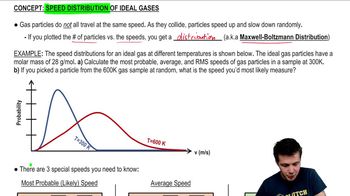
Top Speed

Top speed, denoted as vₘₐₓ, is the maximum velocity that a car can achieve under ideal conditions. It is a critical parameter in the model, as it defines the limit of acceleration. Understanding the relationship between initial acceleration and top speed is essential for deriving the constant k, which quantifies how acceleration diminishes as the car approaches its maximum speed.
추천 영상:
가이드 코스
07:59
Speed Distribution & Special Speeds of Ideal Gases

Exponential Decay

The equation a𝓍 = a₀ - kv𝓍 represents a form of exponential decay, where the acceleration decreases as the velocity increases. The constant k determines the rate of this decay, indicating how quickly the car's acceleration diminishes as it approaches its top speed. This concept is vital for understanding the dynamics of the car's motion and how forces interact as speed increases.
추천 영상:
가이드 코스
04:24
Amplitude Decay in an LRC Circuit
관련 실천
교과서 질문

A rocket is launched straight up with constant acceleration. Four seconds after liftoff, a bolt falls off the side of the rocket. The bolt hits the ground 6.0 s later. What was the rocket's acceleration?

2916
views
1
rank

교과서 질문

When a 1984 Alfa Romeo Spider sports car accelerates at the maximum possible rate, its motion during the first 20 s is extremely well modeled by the simple equation vx2 = (2P/m)t, where P = 3.6 ✕ 10⁴ watts is the car's power output, m = 1200 kg is its mass, and vx is in m/s. That is, the square of the car's velocity increases linearly with time. Find an algebraic expression in terms of P, m, and t for the car's acceleration at time t.

1884
views
교과서 질문

A sprinter can accelerate with constant acceleration for 4.0 s before reaching top speed. He can run the 100 meter dash in 10.0 s. What is his speed as he crosses the finish line?

2450
views
교과서 질문

A good model for the acceleration of a car trying to reach top speed in the least amount of time is a𝓍 = a₀ ─ kv𝓍, where a₀ is the initial acceleration and k is a constant. Find an expression for the car's velocity as a function of time.

1938
views
교과서 질문

A rocket in deep space has an empty mass of 150 kg and exhausts the hot gases of burned fuel at 2500m/s . It is loaded with 600 kg of fuel, which it burns in 30 s. What is the rocket's speed 10 s, 20 s, and 30 s after launch?

1621
views
교과서 질문

Careful measurements have been made of Olympic sprinters in the 100 meter dash. A quite realistic model is that the sprinter's velocity is given by v𝓍 = a ( 1 - e⁻ᵇᵗ ) where t is in s, v𝓍 is in m/s, and the constants a and b are characteristic of the sprinter. Sprinter Carl Lewis's run at the 1987 World Championships is modeled with a = 11.81 m/s and b = 0.6887 s⁻¹. Find an expression for the distance traveled at time t.

427
views