Ch 04: Kinematics in Two Dimensions
Knight Calc - Physics for Scientists and Engineers 5th Edition
Knight Calc5th EditionPhysics for Scientists and EngineersISBN: 9780137344796당신이 사용하는 게 아니라요?교과서 변경
4장, 문제 44

A spaceship maneuvering near Planet Zeta is located at r=(600i−400j+200k)×103km,\(\mathbf{r}\) = (600\(\mathbf{i}\) - 400\(\mathbf{j}\) + 200\(\mathbf{k}\)) \(\times\) 10^3 \, \(\text{km}\), relative to the planet, and traveling at v=9500im/s\(\mathbf{v}\) = 9500\(\mathbf{i}\) \, \(\text{m/s}\). It turns on its thruster engine and accelerates with a=(40i−20k)m/s2\(\mathbf{a}\) = (40\(\mathbf{i}\) - 20\(\mathbf{k}\)) \, \(\text{m/s}\)^2 for 35 min35\(\text{ min}\). What is the spaceship's position when the engine shuts off? Give your answer as a position vector measured in km\(\operatorname{km}\).

검증된 단계별 안내
1
Step 1: Convert the time duration from minutes to seconds. Since 1 minute equals 60 seconds, multiply 35 minutes by 60 to get the time in seconds.
Step 2: Use the kinematic equation for position: r_f = r_i + v_i t + (1/2) a t². Here, r_i is the initial position vector, v_i is the initial velocity vector, a is the acceleration vector, and t is the time duration.
Step 3: Substitute the given values into the equation. The initial position vector is r_i = (600î - 400ĵ + 200k) × 10³ km, the initial velocity vector is v_i = 9500î m/s, and the acceleration vector is a = (40î - 20k) m/s². Ensure all units are consistent, converting the position vector to meters by multiplying by 10³.
Step 4: Calculate each term in the equation. First, compute v_i t by multiplying the velocity vector by the time duration. Then compute (1/2) a t² by squaring the time duration, multiplying by the acceleration vector, and dividing by 2.
Step 5: Add the three vectors (r_i, v_i t, and (1/2) a t²) to find the final position vector. Convert the result back to kilometers by dividing by 10³.

비슷한 문제에 대한 검증된 영상 답변:

이 영상 해법은 위 문제에 도움이 된다고 튜터들이 추천한 것입니다.
영상 길이:
15m

주요 개념

질문에 올바르게 답하기 위해 반드시 이해해야 하는 핵심 개념들은 다음과 같습니다.

Position Vector

A position vector describes the location of a point in space relative to a reference point, typically the origin of a coordinate system. In this context, the spaceship's position vector is given in kilometers and indicates its distance and direction from Planet Zeta. The components of the vector represent the distances along the x, y, and z axes, allowing for a three-dimensional representation of the spaceship's location.
추천 영상:
가이드 코스
07:07
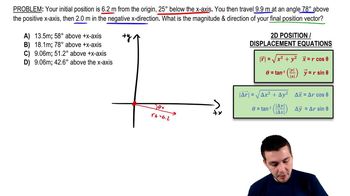
Final Position Vector

Acceleration

Acceleration is the rate of change of velocity of an object over time. It is a vector quantity, meaning it has both magnitude and direction. In this problem, the spaceship accelerates due to its thruster engine, which affects its velocity and ultimately its position. Understanding how to apply acceleration over a given time period is crucial for determining the final position of the spaceship after the engine shuts off.
추천 영상:
가이드 코스
05:47
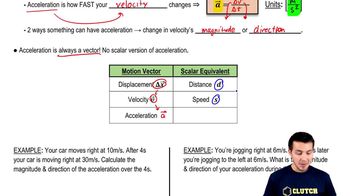
Intro to Acceleration

Kinematic Equations

Kinematic equations describe the motion of objects under constant acceleration. These equations relate displacement, initial velocity, final velocity, acceleration, and time. In this scenario, they are essential for calculating the spaceship's change in position due to its acceleration over a specified time interval. By applying these equations, one can determine the new position vector after the acceleration phase.
추천 영상:
가이드 코스
08:25
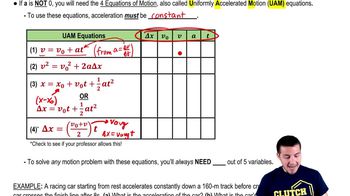
Kinematics Equations