Ch 13: Newton's Theory of Gravity
Knight Calc - Physics for Scientists and Engineers 5th Edition
Knight Calc5th EditionPhysics for Scientists and EngineersISBN: 9780137344796당신이 사용하는 게 아니라요?교과서 변경
13장, 문제 46a

A rogue band of colonists on the moon declares war and prepares to use a catapult to launch large boulders at the earth. Assume that the boulders are launched from the point on the moon nearest the earth. For this problem you can ignore the rotation of the two bodies and the orbiting of the moon. What is the minimum speed with which a boulder must be launched to reach the earth? Hint: The minimum speed is not the escape speed. You need to analyze a three-body system.

검증된 단계별 안내
1
Step 1: Identify the key forces and energies involved in the problem. The boulder must overcome the gravitational pull of both the moon and the earth. This is a three-body system, so we need to consider the gravitational potential energy due to both the moon and the earth.
Step 2: Write the total energy equation for the boulder. The total energy consists of the kinetic energy and the gravitational potential energy. The kinetic energy is given by \( KE = \frac{1}{2}mv^2 \), and the gravitational potential energy is \( U = -\frac{GMm}{r} \), where \( G \) is the gravitational constant, \( M \) is the mass of the celestial body, \( m \) is the mass of the boulder, and \( r \) is the distance from the center of the celestial body.
Step 3: Set up the energy conservation equation. At the launch point on the moon, the boulder has an initial kinetic energy \( KE_{initial} \) and gravitational potential energy due to both the moon and the earth. At the earth's surface, the boulder will have zero velocity (minimum speed condition) and gravitational potential energy due to the earth. Write the equation: \( KE_{initial} + U_{moon} + U_{earth} = U_{earth,final} \).
Step 4: Substitute the expressions for gravitational potential energy. For the moon, \( U_{moon} = -\frac{G M_{moon} m}{R_{moon}} \), where \( M_{moon} \) is the mass of the moon and \( R_{moon} \) is the radius of the moon. For the earth, \( U_{earth} = -\frac{G M_{earth} m}{d} \), where \( M_{earth} \) is the mass of the earth and \( d \) is the distance between the moon and the earth. At the earth's surface, \( U_{earth,final} = -\frac{G M_{earth} m}{R_{earth}} \), where \( R_{earth} \) is the radius of the earth.
Step 5: Solve for the minimum initial velocity \( v \). Rearrange the energy conservation equation to isolate \( v \): \( \frac{1}{2}mv^2 = \left( -\frac{G M_{earth} m}{R_{earth}} \right) - \left( -\frac{G M_{moon} m}{R_{moon}} - \frac{G M_{earth} m}{d} \right) \). Simplify the terms and solve for \( v \). Note that the mass of the boulder \( m \) cancels out, leaving an expression for \( v \) in terms of \( G \), \( M_{moon} \), \( M_{earth} \), \( R_{moon} \), \( R_{earth} \), and \( d \).

비슷한 문제에 대한 검증된 영상 답변:

이 영상 해법은 위 문제에 도움이 된다고 튜터들이 추천한 것입니다.
영상 길이:
14m

주요 개념

질문에 올바르게 답하기 위해 반드시 이해해야 하는 핵심 개념들은 다음과 같습니다.

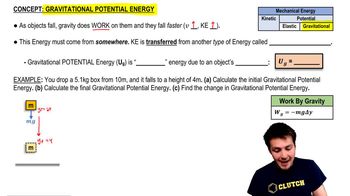
Gravitational Potential Energy

Gravitational potential energy is the energy an object possesses due to its position in a gravitational field. In the context of launching a boulder from the moon to the Earth, this energy is crucial as it determines how much energy is needed to overcome the gravitational pull of the moon and reach the Earth. The potential energy can be calculated using the formula U = -G(m1*m2)/r, where G is the gravitational constant, m1 and m2 are the masses of the two bodies, and r is the distance between their centers.
추천 영상:
가이드 코스
06:35
Gravitational Potential Energy

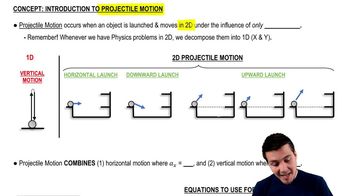
Kinematics of Projectile Motion

Kinematics of projectile motion describes the motion of an object that is launched into the air and is subject to gravitational forces. In this scenario, understanding the initial velocity required for the boulder to reach Earth involves analyzing its trajectory, which is influenced by the gravitational forces of both the moon and the Earth. The equations of motion can be applied to determine the necessary launch angle and speed to ensure the boulder travels the required distance.
추천 영상:
가이드 코스
04:44
Introduction to Projectile Motion

Three-Body Problem

The three-body problem refers to the challenge of predicting the motion of three celestial bodies interacting with each other through gravitational forces. In this case, the moon, Earth, and the boulder represent a three-body system. Unlike simpler two-body problems, the three-body problem does not have a general solution, making it essential to consider the gravitational influences of both the moon and Earth when calculating the minimum speed needed for the boulder to reach its target.
추천 영상:
가이드 코스
08:22
Three-Body Collisions