
Ch 18: A Macroscopic Description of Matter
Knight Calc - Physics for Scientists and Engineers 5th Edition
Knight Calc5th EditionPhysics for Scientists and EngineersISBN: 9780137344796당신이 사용하는 게 아니라요?교과서 변경
18장, 문제 74b

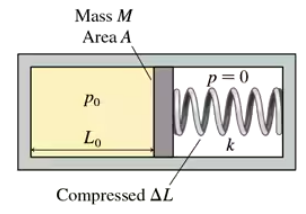
The closed cylinder of FIGURE CP18.74 has a tight-fitting but frictionless piston of mass M. The piston is in equilibrium when the left chamber has pressure p₀ and length L₀ while the spring on the right is compressed by ΔL. Suppose the piston is moved a small distance x to the right. Find an expression for the net force (Fₓ)net on the piston. Assume all motions are slow enough for the gas to remain at the same temperature as its surroundings.

검증된 단계별 안내
1
Step 1: Begin by analyzing the forces acting on the piston. The piston is influenced by the pressure exerted by the gas in the left chamber, the force exerted by the spring in the right chamber, and the gravitational force due to its mass. Since the piston is frictionless, we do not need to account for frictional forces.
Step 2: Write the expression for the pressure force exerted by the gas in the left chamber. The force due to pressure is given by \( F_{\text{gas}} = p \cdot A \), where \( p \) is the pressure in the left chamber and \( A \) is the cross-sectional area of the piston. The pressure \( p \) changes as the piston moves, and can be related to the initial pressure \( p_0 \) using the ideal gas law: \( p \cdot V = p_0 \cdot V_0 \), where \( V \) is the volume of the left chamber.
Step 3: Write the expression for the spring force exerted by the spring in the right chamber. The spring force is given by \( F_{\text{spring}} = -k \cdot (\Delta L + x) \), where \( k \) is the spring constant, \( \Delta L \) is the initial compression of the spring, and \( x \) is the additional displacement of the piston to the right.
Step 4: Combine the forces to find the net force \( F_x \) acting on the piston. The net force is the sum of the pressure force from the left chamber and the spring force from the right chamber, minus the gravitational force: \( F_x = F_{\text{gas}} - F_{\text{spring}} - Mg \). Substitute the expressions for \( F_{\text{gas}} \) and \( F_{\text{spring}} \) into this equation.
Step 5: Simplify the expression for \( F_x \) by substituting \( p \) in terms of \( p_0 \), \( L_0 \), and \( x \) using the ideal gas law. The final expression for \( F_x \) will depend on \( p_0 \), \( L_0 \), \( \Delta L \), \( x \), \( k \), \( A \), and \( M \). Ensure all terms are clearly defined and consistent with the problem setup.

비슷한 문제에 대한 검증된 영상 답변:

이 영상 해법은 위 문제에 도움이 된다고 튜터들이 추천한 것입니다.
영상 길이:
10m

주요 개념

질문에 올바르게 답하기 위해 반드시 이해해야 하는 핵심 개념들은 다음과 같습니다.

Equilibrium in Fluid Mechanics

In fluid mechanics, equilibrium refers to a state where the net forces acting on an object are balanced, resulting in no acceleration. For the piston in the cylinder, this means that the pressure exerted by the gas on one side must equal the pressure exerted by the spring and the atmospheric pressure on the other side when the system is at rest.
추천 영상:
가이드 코스
10:13
Torque & Equilibrium

Ideal Gas Law

The Ideal Gas Law relates the pressure, volume, and temperature of an ideal gas through the equation PV = nRT. In this scenario, since the gas remains at a constant temperature, any change in volume due to the movement of the piston will affect the pressure, which can be analyzed using this law to find the net force acting on the piston.
추천 영상:
가이드 코스
07:21
Ideal Gases and the Ideal Gas Law

Net Force and Newton's Second Law

Newton's Second Law states that the net force acting on an object is equal to the mass of the object multiplied by its acceleration (F = ma). In this case, the net force on the piston can be determined by considering the difference in pressures on either side of the piston and how this pressure difference translates into a force, allowing us to derive an expression for the net force when the piston is displaced.
추천 영상:
가이드 코스
06:54
Intro to Forces & Newton's Second Law