
A linear accelerator uses alternating electric fields to accelerate electrons to close to the speed of light. A small number of the electrons collide with a target, but a large majority pass through the target and impact a beam dump at the end of the accelerator. In one experiment the beam dump measured charge accumulating at a rate of −2.0 nC/s. How many electrons traveled down the accelerator during the 2.0 h run?
Ch 22: Electric Charges and Forces
22장, 문제 4b
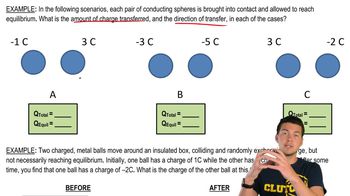
A glass rod that has been charged to +12 nC touches a metal sphere. Afterward, the rod’s charge is +8.0 nC. How many charged particles were transferred?
검증된 단계별 안내1
Understand the problem: The glass rod initially has a charge of +12 nC, and after touching the metal sphere, its charge decreases to +8.0 nC. This means some charge was transferred from the rod to the sphere. The goal is to calculate the number of charged particles (electrons) transferred.
Calculate the amount of charge transferred: Subtract the final charge of the rod from its initial charge. The formula is ΔQ = Q_initial - Q_final, where Q_initial = 12 nC and Q_final = 8.0 nC. This will give the charge transferred in coulombs.
Convert the charge transferred from nanocoulombs (nC) to coulombs (C): Use the conversion factor 1 nC = 1 × 10⁻⁹ C. Multiply the charge transferred (ΔQ) by this factor to express it in coulombs.
Determine the number of electrons transferred: Use the relationship between charge and the elementary charge of an electron. The formula is N = ΔQ / e, where e = 1.6 × 10⁻¹⁹ C (the charge of a single electron). Divide the charge transferred (in coulombs) by the elementary charge to find the number of electrons.
Interpret the result: The value of N represents the number of electrons transferred from the rod to the sphere. Since electrons are negatively charged, the transfer of electrons reduces the positive charge on the rod.

비슷한 문제에 대한 검증된 영상 답변:
이 영상 해법은 위 문제에 도움이 된다고 튜터들이 추천한 것입니다.
영상 길이:
3m주요 개념
질문에 올바르게 답하기 위해 반드시 이해해야 하는 핵심 개념들은 다음과 같습니다.
Charge Conservation
Charge conservation is a fundamental principle in physics stating that the total electric charge in an isolated system remains constant over time. When two objects interact, such as a charged rod and a metal sphere, charge can be transferred between them, but the overall charge before and after the interaction must remain the same.
추천 영상:
가이드 코스
Conservation of Charge
Quantization of Charge
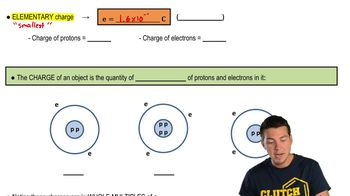
Electric charge is quantized, meaning it exists in discrete amounts, typically in multiples of the elementary charge (approximately 1.6 x 10^-19 coulombs). This concept is crucial for understanding how many elementary charges (or charged particles) are involved in the transfer of charge between objects, as each particle carries a specific amount of charge.
추천 영상:
가이드 코스
Electric Charge
Conductors and Charge Transfer
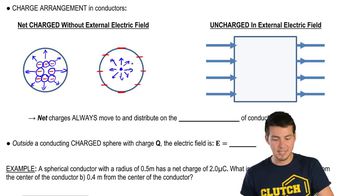
Conductors are materials that allow electric charge to flow freely due to the presence of free electrons. When a charged object, like a glass rod, touches a conductor such as a metal sphere, charge can redistribute between them, leading to a change in their respective charge states. This interaction is key to determining how many charged particles are transferred during the process.
추천 영상:
가이드 코스
Electric Fields in Conductors
관련 실천
교과서 질문
1637
views
교과서 질문
3.5×10¹⁰ electrons are added to a plastic rod by rubbing it with wool. What is the charge on the rod?
2104
views
교과서 질문
A plastic rod that has been charged to −15 nC touches a metal sphere. Afterward, the rod's charge is −10 nC. How many charged particles were transferred?
1900
views
교과서 질문
What is the total charge of all the electrons in L of liquid water?
1898
views
교과서 질문
A plastic rod that has been charged to −15 nC touches a metal sphere. Afterward, the rod's charge is −10 nC. What kind of charged particle was transferred between the rod and the sphere, and in which direction? That is, did it move from the rod to the sphere or from the sphere to the rod?
1242
views
교과서 질문
What mass of aluminum has a total nuclear charge of C? Aluminum has atomic number .
2424
views
2
comments
