Ch 29: The Magnetic Field
Knight Calc - Physics for Scientists and Engineers 5th Edition
Knight Calc5th EditionPhysics for Scientists and EngineersISBN: 9780137344796당신이 사용하는 게 아니라요?교과서 변경
29장, 문제 45

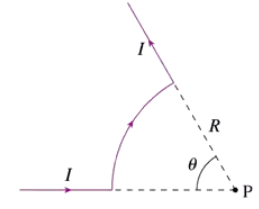
Find an expression for the magnetic field strength at the center (point P) of the circular arc in FIGURE P29.45.

검증된 단계별 안내
1
Identify the relevant formula for the magnetic field produced by a current-carrying wire. For a segment of wire forming a circular arc, the magnetic field at the center is given by the Biot-Savart law: B = (μ₀Iθ)/(4πR), where μ₀ is the permeability of free space, I is the current, θ is the angle subtended by the arc in radians, and R is the radius of the arc.
Determine the angle subtended by the arc at the center, θ. If the problem specifies the angle in degrees, convert it to radians using the formula: θ_{\(\text{radians}\)} = θ_{\(\text{degrees}\)} × (π/180).
Substitute the given values for the current I, the radius R, and the angle θ into the formula B = (μ₀Iθ)/(4πR). Ensure all units are consistent (e.g., current in amperes, radius in meters, and angle in radians).
Simplify the expression to isolate the magnetic field strength B. This involves performing algebraic operations to combine constants and variables.
Verify the derived expression for correctness by checking the units. The magnetic field strength B should have units of teslas (T), which are equivalent to N/(A·m).

비슷한 문제에 대한 검증된 영상 답변:

이 영상 해법은 위 문제에 도움이 된다고 튜터들이 추천한 것입니다.

주요 개념

질문에 올바르게 답하기 위해 반드시 이해해야 하는 핵심 개념들은 다음과 같습니다.

Magnetic Field

The magnetic field is a vector field that describes the magnetic influence on moving electric charges, electric currents, and magnetic materials. It is represented by the symbol B and is measured in teslas (T). The strength and direction of the magnetic field can be determined using the right-hand rule, which relates the direction of current flow to the orientation of the magnetic field lines.
추천 영상:
가이드 코스
05:30
Magnetic Fields and Magnetic Dipoles

Biot-Savart Law

The Biot-Savart Law provides a mathematical description of the magnetic field generated by a current-carrying conductor. It states that the magnetic field dB at a point in space is directly proportional to the current I, the length element dl of the conductor, and the sine of the angle between dl and the line connecting the element to the point, divided by the square of the distance r from the element to the point. This law is essential for calculating the magnetic field due to complex current configurations.
추천 영상:
가이드 코스
04:53
Biot-Savart Law with Calculus

Circular Arc

A circular arc is a segment of a circle defined by two endpoints and the continuous curve between them. In the context of magnetic fields, a circular arc carrying current generates a magnetic field that can be analyzed using symmetry and the Biot-Savart Law. The magnetic field at the center of the arc is particularly significant, as it can be derived from the contributions of each infinitesimal segment of the arc, leading to a simplified expression for the total magnetic field strength.
추천 영상:
가이드 코스
03:48
Intro to Circular Motion
관련 실천
교과서 질문

A small bar magnet experiences a 0.020 N m torque when the axis of the magnet is at 45° to a 0.10 T magnetic field. What is the magnitude of its magnetic dipole moment?

441
views

교과서 질문

The heart produces a weak magnetic field that can be used to diagnose certain heart problems. It is a dipole field produced by a current loop in the outer layers of the heart. What is the magnitude of the heart's magnetic dipole moment?

418
views
교과서 질문

The earth's magnetic field, with a magnetic dipole moment of 8.0 x 10²² A m2, is generated by currents within the molten iron of the earth's outer core. Suppose we model the core current as a 3000-km-diameter current loop made from a 1000-km-diameter 'wire.' The loop diameter is measured from the centers of this very fat wire. What is the current density J in the current loop?

114
views
교과서 질문

A long wire carrying a 5.0 A current perpendicular to the xy-plane intersects the x-axis at x = -2.0 cm. A second, parallel wire carrying a 3.0 A current intersects the x-axis at x = +2.0 cm. At what point or points on the x-axis is the magnetic field zero if (a) the two currents are in the same direction and (b) the two currents are in opposite directions?

172
views
교과서 질문

Each turn of a solenoid is a current loop with a magnetic dipole moment. Consider a 200-turn cylindrical solenoid that has an interior volume of 40 cm3 and for which each turn is a magnetic dipole moment with magnitude 8.0 x 10⁻⁴ A m2. What is the magnetic field strength inside the solenoid?

1301
views
교과서 질문

When seen from the end, three long, parallel wires form an equilateral triangle 6.0 cm on a side. The wires each carry a 5.0 A current, with one current direction opposite the other two. What is the magnetic field strength at the center of the triangle?

151
views