
Ch 40: One-Dimensional Quantum Mechanics
Knight Calc - Physics for Scientists and Engineers 5th Edition
Knight Calc5th EditionPhysics for Scientists and EngineersISBN: 9780137344796당신이 사용하는 게 아니라요?교과서 변경
40장, 문제 45

A proton’s energy is 1.0 MeV below the top of a 10-fm-wide energy barrier. What is the probability that the proton will tunnel through the barrier?

검증된 단계별 안내
1
Step 1: Understand the problem. The proton is attempting to tunnel through a potential energy barrier. The given data includes the proton's energy (1.0 MeV below the barrier), the width of the barrier (10 fm), and the need to calculate the tunneling probability using quantum mechanics principles.
Step 2: Use the formula for tunneling probability in quantum mechanics: \( T \approx e^{-2 \kappa L} \), where \( \kappa \) is the decay constant, and \( L \) is the width of the barrier. Here, \( L = 10 \; \text{fm} \).
Step 3: Calculate \( \kappa \) using the formula \( \kappa = \sqrt{\frac{2m(U - E)}{\hbar^2}} \), where \( m \) is the mass of the proton, \( U \) is the height of the barrier, \( E \) is the energy of the proton, and \( \hbar \) is the reduced Planck's constant. Substitute the known values: \( U - E = 1.0 \; \text{MeV} \), \( m = 1.67 \times 10^{-27} \; \text{kg} \), and \( \hbar = 1.055 \times 10^{-34} \; \text{J·s} \).
Step 4: Convert the energy difference \( U - E \) from MeV to joules using the conversion factor \( 1 \; \text{MeV} = 1.602 \times 10^{-13} \; \text{J} \). This ensures all units are consistent for the calculation of \( \kappa \).
Step 5: Substitute the calculated \( \kappa \) and \( L \) into the tunneling probability formula \( T \approx e^{-2 \kappa L} \). Simplify the expression to find the approximate tunneling probability.

비슷한 문제에 대한 검증된 영상 답변:

이 영상 해법은 위 문제에 도움이 된다고 튜터들이 추천한 것입니다.

주요 개념

질문에 올바르게 답하기 위해 반드시 이해해야 하는 핵심 개념들은 다음과 같습니다.

Quantum Tunneling

Quantum tunneling is a phenomenon in quantum mechanics where a particle has a probability of passing through a potential energy barrier, even if its energy is less than the height of the barrier. This occurs because particles exhibit wave-like properties, allowing them to exist in a superposition of states, which can extend into classically forbidden regions.

Potential Energy Barrier

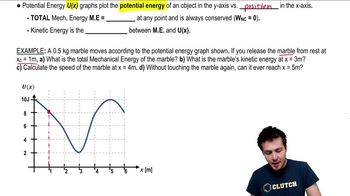
A potential energy barrier is a region in space where the potential energy of a particle is higher than its total energy. In this context, the barrier is 10 femtometers wide, and the proton's energy being 1.0 MeV below the barrier height indicates that it does not have enough energy to overcome the barrier classically, making tunneling a relevant consideration.
추천 영상:
가이드 코스
07:24
Potential Energy Graphs

Wave Function and Probability

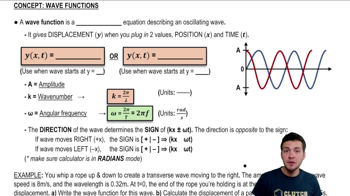
In quantum mechanics, the wave function describes the quantum state of a particle and contains all the information about its position and momentum. The probability of finding a particle in a certain region is given by the square of the wave function's amplitude. For tunneling, the wave function's behavior in the barrier region determines the likelihood of the particle's successful passage through the barrier.
추천 영상:
가이드 코스
08:30
Intro to Wave Functions