
Ch 05: Applying Newton's Laws
Young & Freedman Calc - University Physics 14th Edition
Young & Freedman Calc14th EditionUniversity PhysicsISBN: 9780321973610당신이 사용하는 게 아니라요?교과서 변경
5장, 문제 24

A 5.005.00-kg crate is suspended from the end of a short vertical rope of negligible mass. An upward force F(t)F(t) is applied to the end of the rope, and the height of the crate above its initial position is given by y(t)=y(t) = (2.802.80 m/s)t + (0.6100.610 m/s3)t3. What is the magnitude of FF when t=4.00t = 4.00 s?

검증된 단계별 안내
1
Step 1: Begin by identifying the forces acting on the crate. The forces include the gravitational force acting downward, which is given by F_gravity = m * g, where m is the mass of the crate (5.00 kg) and g is the acceleration due to gravity (approximately 9.8 m/s²), and the applied force F(t) acting upward.
Step 2: To find the net force acting on the crate, calculate the acceleration of the crate at time t = 4.00 s. The height y(t) is given as a function of time: y(t) = (2.80 m/s)t + (0.610 m/s³)t³. Differentiate y(t) with respect to t to find the velocity v(t), and then differentiate v(t) to find the acceleration a(t).
Step 3: Perform the differentiation. First, find v(t) = dy/dt = 2.80 m/s + 3 * (0.610 m/s³)t². Then, find a(t) = dv/dt = 6 * (0.610 m/s³)t. Substitute t = 4.00 s into a(t) to calculate the acceleration at that specific time.
Step 4: Use Newton's second law, F_net = m * a, to find the net force acting on the crate. Here, m is the mass of the crate (5.00 kg) and a is the acceleration calculated in the previous step. The net force is the difference between the applied force F(t) and the gravitational force F_gravity.
Step 5: Solve for the applied force F(t) using the equation F(t) = F_net + F_gravity. Substitute the values of F_net (from Step 4) and F_gravity = m * g into the equation. This will give the magnitude of the applied force F(t) at t = 4.00 s.

비슷한 문제에 대한 검증된 영상 답변:

이 영상 해법은 위 문제에 도움이 된다고 튜터들이 추천한 것입니다.
영상 길이:
3m

주요 개념

질문에 올바르게 답하기 위해 반드시 이해해야 하는 핵심 개념들은 다음과 같습니다.

Newton's Second Law of Motion

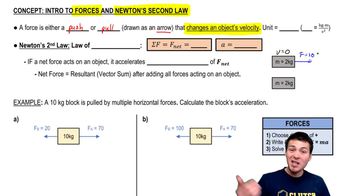
Newton's Second Law states that the acceleration of an object is directly proportional to the net force acting on it and inversely proportional to its mass. This relationship is expressed by the equation F = ma, where F is the net force, m is the mass, and a is the acceleration. Understanding this law is crucial for analyzing the forces acting on the crate, especially when determining the applied force F(t) at a specific time.
추천 영상:
가이드 코스
06:54
Intro to Forces & Newton's Second Law

Kinematics of Motion

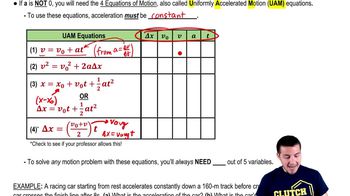
Kinematics is the branch of mechanics that describes the motion of objects without considering the forces that cause the motion. The height function y(t) = (2.80 m/s)t + (0.610 m/s³)t³ provides information about the crate's position over time. By differentiating this function, we can find the velocity and acceleration, which are essential for applying Newton's Second Law to find the force F at t = 4.00 s.
추천 영상:
가이드 코스
08:25
Kinematics Equations

Net Force and Weight

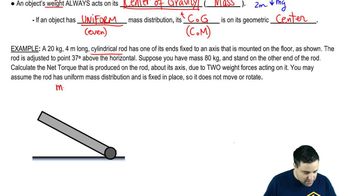
The net force acting on an object is the vector sum of all forces acting on it. For the crate, this includes the upward force F(t) and the downward gravitational force, which is the weight (W = mg). At any time, the net force can be calculated by subtracting the weight from the applied force, allowing us to solve for F(t) when the crate's acceleration is known.
추천 영상:
가이드 코스
10:19
Torque Due to Weight
관련 실천
교과서 질문

When jumping straight up from a crouched position, an average person can reach a maximum height of about 6060 cm. During the jump, the person's body from the knees up typically rises a distance of around 5050 cm. To keep the calculations simple and yet get a reasonable result, assume that the entire body rises this much during the jump. In terms of this jumper's weight w, what force does the ground exert on him or her during the jump?

1557
views
교과서 질문

When jumping straight up from a crouched position, an average person can reach a maximum height of about 6060 cm. During the jump, the person's body from the knees up typically rises a distance of around 5050 cm. To keep the calculations simple and yet get a reasonable result, assume that the entire body rises this much during the jump. Draw a free-body diagram of the person during the jump.

2609
views
교과서 질문

In a laboratory experiment on friction, a 135135-N block resting on a rough horizontal table is pulled by a horizontal wire. The pull gradually increases until the block begins to move and continues to increase thereafter. Figure E5.265.26 shows a graph of the friction force on this block as a function of the pull. Identify the regions of the graph where static friction and kinetic friction occur.

2748
views
교과서 질문

A box of bananas weighing 40.0 40.0 N rests on a horizontal surface. The coefficient of static friction between the box and the surface is 0.400.40, and the coefficient of kinetic friction is 0.200.20. If no horizontal force is applied to the box and the box is at rest, how large is the friction force exerted on it?

1842
views
1
rank
교과서 질문

A 2.002.00-kg box is moving to the right with speed 9.009.00 m/s on a horizontal, frictionless surface. At t=0t = 0 a horizontal force is applied to the box. The force is directed to the left and has magnitude F(t)=F(t) = (6.006.00 N/s2)t2. What distance does the box move from its position at t=0t = 0 before its speed is reduced to zero?

187
views
교과서 질문

A box of bananas weighing 40.0 40.0 N rests on a horizontal surface. The coefficient of static friction between the box and the surface is 0.400.40, and the coefficient of kinetic friction is 0.200.20. What is the magnitude of the friction force if a monkey applies a horizontal force of 6.06.0 N to the box and the box is initially at rest?

1838
views