Ch 19: The First Law of Thermodynamics
Young & Freedman Calc - University Physics 14th Edition
Young & Freedman Calc14th EditionUniversity PhysicsISBN: 9780321973610당신이 사용하는 게 아니라요?교과서 변경
19장, 문제 15c

An ideal gas is taken from aa to bb on the pVpV-diagram shown in Fig. E19.1519.15. During this process, 700700 J of heat is added and the pressure doubles. How does the internal energy of the gas at aa compare to the internal energy at bb? Be specific and explain.
pV diagram illustrating points a and b with pressure and volume values.

검증된 단계별 안내
1
Identify the initial and final states of the gas on the pV-diagram. The initial state 'a' is at a pressure of 30.0 kPa and a volume of 0.050 m³. The final state 'b' is at the same volume but with double the pressure, 60.0 kPa.
Recall the first law of thermodynamics, which states that the change in internal energy (ΔU) of a system is equal to the heat added to the system (Q) minus the work done by the system (W): ΔU = Q - W.
Since the process is vertical on the pV-diagram, the volume does not change, indicating that no work is done by the gas (W = 0) because work done by a gas is given by W = PΔV, and ΔV = 0.
Substitute the given values into the first law of thermodynamics equation: ΔU = 700 J - 0 J, which simplifies to ΔU = 700 J.
Conclude that the internal energy of the gas at state 'b' is 700 J greater than at state 'a', since the entire heat added to the system increases the internal energy due to no work being done.

비슷한 문제에 대한 검증된 영상 답변:

이 영상 해법은 위 문제에 도움이 된다고 튜터들이 추천한 것입니다.
영상 길이:
2m

주요 개념

질문에 올바르게 답하기 위해 반드시 이해해야 하는 핵심 개념들은 다음과 같습니다.

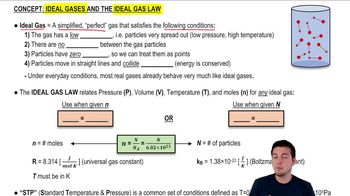
Ideal Gas Law

The Ideal Gas Law relates the pressure, volume, temperature, and number of moles of an ideal gas through the equation PV = nRT. This law is fundamental in understanding the behavior of gases under various conditions, allowing us to predict how changes in one variable affect the others. In this scenario, the pressure and volume changes are crucial for analyzing the internal energy of the gas.
추천 영상:
가이드 코스
07:21
Ideal Gases and the Ideal Gas Law

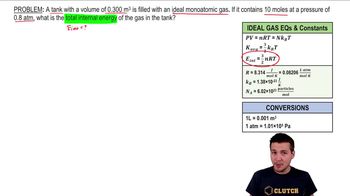
Internal Energy

Internal energy is the total energy contained within a system, primarily due to the kinetic and potential energies of its molecules. For an ideal gas, the internal energy is directly proportional to its temperature and can be calculated using the formula U = (3/2)nRT for a monatomic gas. Understanding how internal energy changes during processes, such as heating or work done, is essential for solving the given problem.
추천 영상:
가이드 코스
04:54
Total Internal Energy

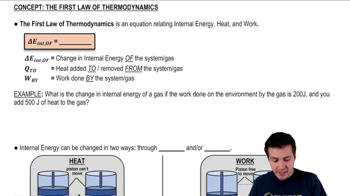
First Law of Thermodynamics

The First Law of Thermodynamics states that the change in internal energy of a system is equal to the heat added to the system minus the work done by the system: ΔU = Q - W. This principle is vital for analyzing the energy transfers in the gas as it moves from state 'a' to state 'b', especially since heat is added and pressure changes, affecting the internal energy at both points.
추천 영상:
가이드 코스
08:04
The First Law of Thermodynamics
관련 실천
교과서 질문

A cylinder contains 0.01000.0100 mol of helium at T=27.0T = 27.0°C. If instead the pressure of the helium is kept constant, how much heat is needed to raise the temperature from 27.027.0°C to 67.067.0°C? Draw a pVpV-diagram for this process.

1335
views
교과서 질문

During an isothermal compression of an ideal gas, 410410 J of heat must be removed from the gas to maintain constant temperature. How much work is done by the gas during the process?

2456
views
교과서 질문

The pVpV-diagram in Fig. E19.1319.13 shows a process abcabc involving 0.4500.450 mol of an ideal gas. How much heat had to be added during the process to increase the internal energy of the gas by 15,00015,000 J?

2232
views
교과서 질문

When water is boiled at a pressure of 2.002.00 atm, the heat of vaporization is 2.20×1062.20\(\times\)10^6 J/kg and the boiling point is 120120°C. At this pressure, 1.001.00 kg of water has a volume of 1.00×10−31.00\(\times\)10^{-3} m3, and 1.001.00 kg of steam has a volume of 0.8240.824 m3. Compute the increase in internal energy of the water.

1798
views
교과서 질문

A cylinder contains 0.01000.0100 mol of helium at T=27.0T = 27.0°C. How much heat is needed to raise the temperature to 67.067.0°C while keeping the volume constant? Draw a pVpV-diagram for this process.

1378
views
교과서 질문

When water is boiled at a pressure of 2.002.00 atm, the heat of vaporization is 2.20×1062.20\(\times\)10^6 J/kg and the boiling point is 120120°C. At this pressure, 1.001.00 kg of water has a volume of 1.00×10−31.00\(\times\)10^{-3} m3, and 1.001.00 kg of steam has a volume of 0.8240.824 m3. Compute the work done when 1.001.00 kg of steam is formed at this temperature.

4116
views