Ch 20: The Second Law of Thermodynamics
Young & Freedman Calc - University Physics 14th Edition
Young & Freedman Calc14th EditionUniversity PhysicsISBN: 9780321973610당신이 사용하는 게 아니라요?교과서 변경
20장, 문제 31

A lonely party balloon with a volume of 2.402.40 L and containing 0.1000.100 mol of air is left behind to drift in the temporarily uninhabited and depressurized International Space Station. Sunlight coming through a porthole heats and explodes the balloon, causing the air in it to undergo a free expansion into the empty station, whose total volume is 425425 m3. Calculate the entropy change of the air during the expansion.

검증된 단계별 안내
1
Understand the concept of entropy change during free expansion: In a free expansion, the gas expands into a vacuum without doing work and without heat exchange. The entropy change is determined by the change in the number of accessible microstates.
Identify the initial and final states of the system: Initially, the air is confined to a volume of 2.40 L. After expansion, it occupies the entire volume of the space station, which is 425 m³. Convert the initial volume to cubic meters for consistency: 2.40 L = 0.00240 m³.
Use the formula for entropy change in free expansion: The entropy change \( \Delta S \) can be calculated using the formula \( \Delta S = nR \ln \left( \frac{V_f}{V_i} \right) \), where \( n \) is the number of moles, \( R \) is the ideal gas constant (8.314 J/mol·K), \( V_f \) is the final volume, and \( V_i \) is the initial volume.
Substitute the known values into the formula: \( n = 0.100 \) mol, \( V_i = 0.00240 \) m³, \( V_f = 425 \) m³, and \( R = 8.314 \) J/mol·K. Calculate the natural logarithm of the volume ratio \( \ln \left( \frac{425}{0.00240} \right) \).
Calculate the entropy change \( \Delta S \) using the substituted values: \( \Delta S = 0.100 \times 8.314 \times \ln \left( \frac{425}{0.00240} \right) \). This will give you the entropy change in joules per kelvin (J/K).

비슷한 문제에 대한 검증된 영상 답변:

이 영상 해법은 위 문제에 도움이 된다고 튜터들이 추천한 것입니다.
영상 길이:
5m

주요 개념

질문에 올바르게 답하기 위해 반드시 이해해야 하는 핵심 개념들은 다음과 같습니다.

Entropy

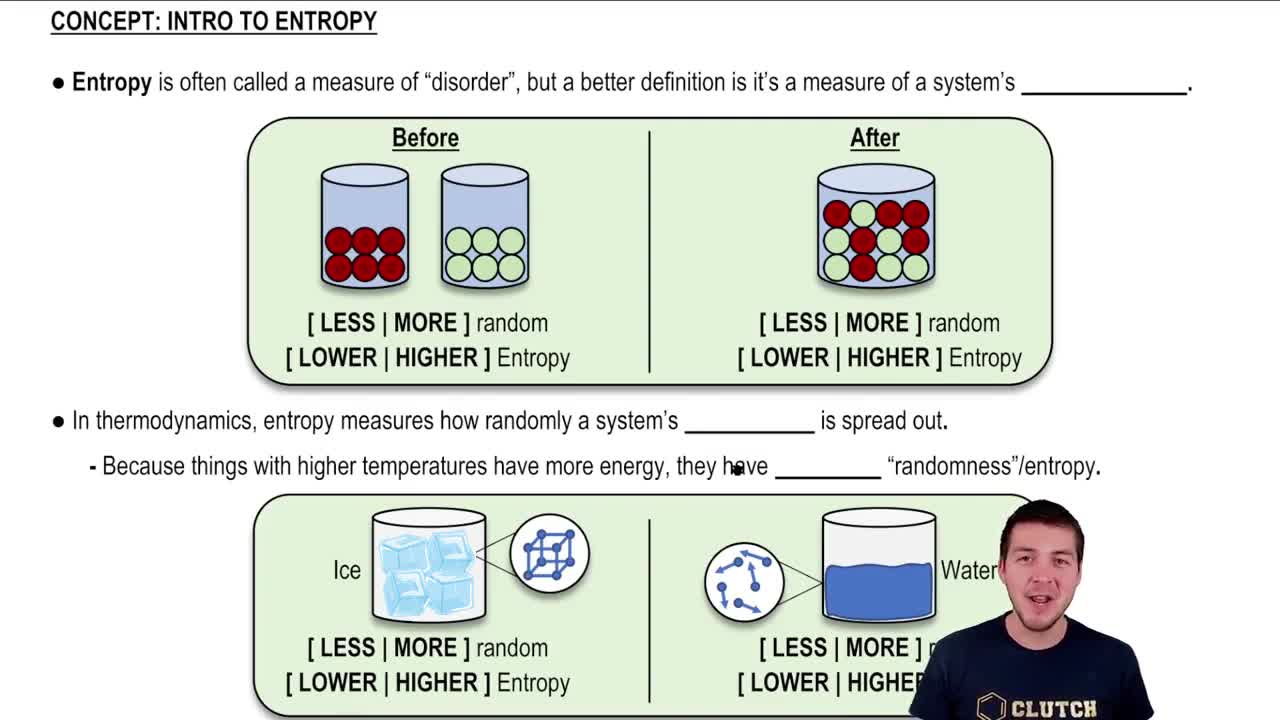
Entropy is a measure of the disorder or randomness in a system. In thermodynamics, it quantifies the amount of energy in a system that is unavailable to do work. During a free expansion, such as the one described in the question, the entropy of the system increases because the gas molecules spread out into a larger volume, increasing disorder.
추천 영상:
가이드 코스
07:50
Intro to Entropy

Free Expansion

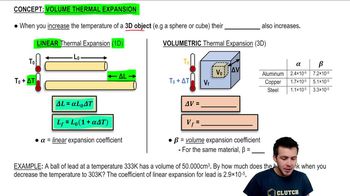
Free expansion is a process where a gas expands into an evacuated space without doing work on the surroundings and without heat exchange. It is an irreversible process, and in an ideal gas, it results in an increase in entropy. The internal energy remains constant because no work is done and no heat is transferred.
추천 영상:
가이드 코스
05:21
Volume Thermal Expansion

Ideal Gas Law

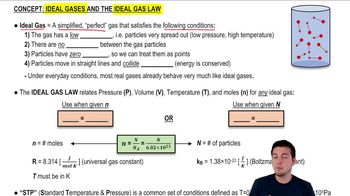
The Ideal Gas Law is a fundamental equation in thermodynamics, expressed as PV = nRT, where P is pressure, V is volume, n is the number of moles, R is the gas constant, and T is temperature. It describes the behavior of an ideal gas and is used to relate the initial and final states of the gas in processes like expansion, helping to calculate changes in properties such as entropy.
추천 영상:
가이드 코스
07:21
Ideal Gases and the Ideal Gas Law