
Ch 02: Motion Along a Straight Line
Young & Freedman Calc - University Physics 15th Edition
Young & Freedman Calc15th EditionUniversity PhysicsISBN: 9780135159552당신이 사용하는 게 아니라요?교과서 변경
2장, 문제 24a

A car sits on an entrance ramp to a freeway, waiting for a break in the traffic. Then the driver accelerates with constant acceleration along the ramp and onto the freeway. The car starts from rest, moves in a straight line, and has a speed of 2020 m/s (4545 mi/h) when it reaches the end of the 120120-m-long ramp. What is the acceleration of the car?

검증된 단계별 안내
1
Identify the known values: initial velocity (v₀) = 0 m/s (since the car starts from rest), final velocity (v) = 20 m/s, and displacement (s) = 120 m.
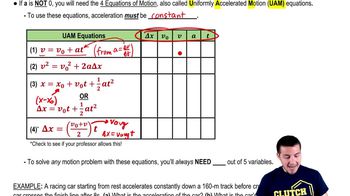
Use the kinematic equation that relates these quantities: v² = v₀² + 2as, where v is the final velocity, v₀ is the initial velocity, a is the acceleration, and s is the displacement.
Substitute the known values into the equation: (20 m/s)² = (0 m/s)² + 2a(120 m).
Simplify the equation to solve for acceleration (a): 400 m²/s² = 240a m.
Rearrange the equation to isolate a: a = 400 m²/s² / 240 m.

비슷한 문제에 대한 검증된 영상 답변:

이 영상 해법은 위 문제에 도움이 된다고 튜터들이 추천한 것입니다.
영상 길이:
2m

주요 개념

질문에 올바르게 답하기 위해 반드시 이해해야 하는 핵심 개념들은 다음과 같습니다.

Kinematics Equations

Kinematics equations describe the motion of objects without considering the forces that cause the motion. For constant acceleration, the equation v^2 = u^2 + 2as can be used, where v is the final velocity, u is the initial velocity, a is the acceleration, and s is the displacement. This equation helps determine the car's acceleration given its initial and final velocities and the distance traveled.
추천 영상:
가이드 코스
08:25
Kinematics Equations

Constant Acceleration

Constant acceleration implies that the rate of change of velocity is uniform over time. In this scenario, the car's acceleration remains the same throughout its motion on the ramp. Understanding constant acceleration is crucial for applying kinematic equations correctly, as it simplifies calculations by allowing the use of specific formulas designed for uniform acceleration.
추천 영상:
가이드 코스
08:59
Phase Constant of a Wave Function

Initial Conditions

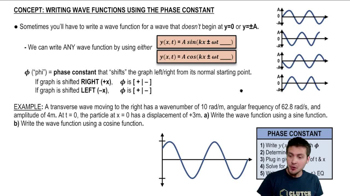
Initial conditions refer to the state of an object at the beginning of its motion. Here, the car starts from rest, meaning its initial velocity is zero. Recognizing initial conditions is essential for solving physics problems, as they provide the necessary starting point for applying kinematic equations and determining other variables like acceleration or time.
추천 영상:
관련 실천
교과서 질문

A car sits on an entrance ramp to a freeway, waiting for a break in the traffic. Then the driver accelerates with constant acceleration along the ramp and onto the freeway. The car starts from rest, moves in a straight line, and has a speed of 2020 m/s (4545 mi/h) when it reaches the end of the 120120-m-long ramp. How much time does it take the car to travel the length of the ramp?

1993
views
2
rank
교과서 질문

A cat walks in a straight line, which we shall call the xx-axis, with the positive direction to the right. As an observant physicist, you make measurements of this cat's motion and construct a graph of the feline's velocity as a function of time (Fig. E2.302.30). What is the cat's acceleration at t=3.0t = 3.0 s? At t=6.0t = 6.0 s? At t=7.0t = 7.0 s?

2096
views
교과서 질문

A cat walks in a straight line, which we shall call the xx-axis, with the positive direction to the right. As an observant physicist, you make measurements of this cat's motion and construct a graph of the feline's velocity as a function of time (Fig. E2.302.30). Find the cat's velocity at t=4.0t = 4.0 s and at t=7.0t = 7.0 s.

2857
views
교과서 질문

In the fastest measured tennis serve, the ball left the racquet at 73.1473.14 m/s. A served tennis ball is typically in contact with the racquet for 30.030.0 ms and starts from rest. Assume constant acceleration. What was the ball's acceleration during this serve?

3190
views
1
rank
교과서 질문

The fastest measured pitched baseball left the pitcher's hand at a speed of 45.045.0 m/s. If the pitcher was in contact with the ball over a distance of 1.501.50 m and produced constant acceleration, what acceleration did he give the ball?

2938
views
교과서 질문

The human body can survive an acceleration trauma incident (sudden stop) if the magnitude of the acceleration is less than 250250 m/s2. If you are in an automobile accident with an initial speed of 105105 km/h (6565 mi/h) and are stopped by an airbag that inflates from the dashboard, over what distance must the airbag stop you for you to survive the crash?

4240
views