Ch 02: Motion Along a Straight Line
Young & Freedman Calc - University Physics 15th Edition
Young & Freedman Calc15th EditionUniversity PhysicsISBN: 9780135159552당신이 사용하는 게 아니라요?교과서 변경
2장, 문제 49b

A rocket starts from rest and moves upward from the surface of the earth. For the first 10.010.0 s of its motion, the vertical acceleration of the rocket is given by ay=(2.80a_{y}=(2.80 m/s3)t)t, where the +y+y-direction is upward. What is the speed of the rocket when it is 325325 m above the surface of the earth?

검증된 단계별 안내
1
Identify the given information: The rocket starts from rest, so the initial velocity (v0) is 0 m/s. The acceleration is given as a function of time: ay = (2.80 m/s^3)t. We need to find the speed of the rocket when it is 325 m above the surface.
Use the kinematic equation for position with variable acceleration: s = ∫v dt, where v = ∫a dt. First, find the velocity function by integrating the acceleration: v(t) = ∫(2.80 m/s^3)t dt.
Calculate the velocity function: v(t) = (2.80 m/s^3)(t^2)/2 + C. Since the rocket starts from rest, the constant C is 0. Therefore, v(t) = 1.40 m/s^3 * t^2.
Use the position function: s(t) = ∫v(t) dt = ∫(1.40 m/s^3 * t^2) dt. Integrate to find the position function: s(t) = (1.40 m/s^3)(t^3)/3 + C. Since the initial position is 0, C is 0, so s(t) = 0.467 m/s^3 * t^3.
Solve for the time when the rocket is 325 m above the surface: Set s(t) = 325 m and solve for t. Once t is found, substitute it back into the velocity function v(t) = 1.40 m/s^3 * t^2 to find the speed of the rocket at that height.

비슷한 문제에 대한 검증된 영상 답변:

이 영상 해법은 위 문제에 도움이 된다고 튜터들이 추천한 것입니다.
영상 길이:
4m

주요 개념

질문에 올바르게 답하기 위해 반드시 이해해야 하는 핵심 개념들은 다음과 같습니다.

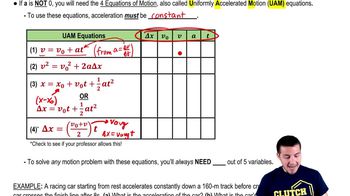
Kinematics Equations

Kinematics equations describe the motion of objects without considering the forces that cause the motion. They relate displacement, velocity, acceleration, and time. In this problem, the kinematic equation v = u + at is crucial, where v is the final velocity, u is the initial velocity, a is the acceleration, and t is the time.
추천 영상:
가이드 코스
08:25
Kinematics Equations

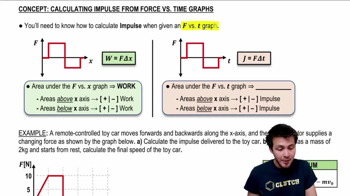
Variable Acceleration

Variable acceleration occurs when the acceleration of an object changes with time. In this scenario, the rocket's acceleration is given as a function of time, ay = (2.80 m/s³)t. To find the velocity, we need to integrate this acceleration function with respect to time, considering the initial conditions.
추천 영상:
가이드 코스
05:28
Impulse with Variable Forces

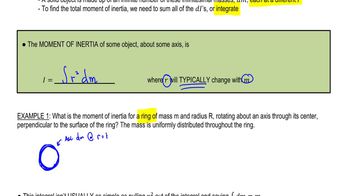
Integration in Physics

Integration is a mathematical process used to find quantities like displacement or velocity when given a rate of change, such as acceleration. For this problem, integrating the acceleration function ay = (2.80 m/s³)t with respect to time will yield the velocity function, which can then be evaluated to find the speed at a specific height.
추천 영상:
가이드 코스
11:43
Finding Moment Of Inertia By Integrating