Ch 02: Motion Along a Straight Line
Young & Freedman Calc - University Physics 15th Edition
Young & Freedman Calc15th EditionUniversity PhysicsISBN: 9780135159552당신이 사용하는 게 아니라요?교과서 변경
2장, 문제 13a

A turtle crawls along a straight line, which we will call the xx-axis with the positive direction to the right. The equation for the turtle's position as a function of time is x(t)=50.0x(t) = 50.0 cm + (2.002.00 cm/s)tt − (0.06250.0625 cm/s2)t2t^2. Find the turtle's initial velocity, initial position, and initial acceleration.

검증된 단계별 안내
1
Identify the given position function: x(t) = 50.0 cm + (2.00 cm/s)t − (0.0625 cm/s^2)t^2. This is a quadratic equation in the form of x(t) = x_0 + v_0*t + (1/2)*a*t^2, where x_0 is the initial position, v_0 is the initial velocity, and a is the acceleration.
Determine the initial position (x_0) by evaluating the position function at t = 0. This gives x_0 = 50.0 cm.
Find the initial velocity (v_0) by identifying the coefficient of the linear term in the position function. The term (2.00 cm/s)t indicates that the initial velocity v_0 is 2.00 cm/s.
Calculate the initial acceleration (a) by identifying the coefficient of the quadratic term in the position function. The term (0.0625 cm/s^2)t^2 corresponds to (1/2)*a*t^2, so solve for a: a = 2 * 0.0625 cm/s^2.
Summarize the findings: The turtle's initial position is 50.0 cm, the initial velocity is 2.00 cm/s, and the initial acceleration is 0.125 cm/s^2.

비슷한 문제에 대한 검증된 영상 답변:

이 영상 해법은 위 문제에 도움이 된다고 튜터들이 추천한 것입니다.
영상 길이:
3m
도움이 되었나요?

주요 개념

질문에 올바르게 답하기 위해 반드시 이해해야 하는 핵심 개념들은 다음과 같습니다.

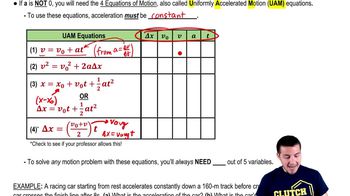
Kinematic Equations

Kinematic equations describe the motion of objects in terms of displacement, velocity, acceleration, and time. In this problem, the position function x(t) = 50.0 cm + (2.00 cm/s)t − (0.0625 cm/s^2)t^2 is a kinematic equation that provides the turtle's position as a function of time, allowing us to extract initial conditions and understand the motion dynamics.
추천 영상:
08:25
Kinematics Equations

Initial Conditions

Initial conditions refer to the values of position, velocity, and acceleration at the start of observation (t = 0). For the turtle, the initial position is the constant term in the equation (50.0 cm), the initial velocity is the coefficient of t (2.00 cm/s), and the initial acceleration is twice the coefficient of t^2, which is -0.125 cm/s^2, derived from the equation's structure.
추천 영상:
04:40
Example

Differentiation in Physics

Differentiation is a mathematical process used to find rates of change, such as velocity and acceleration, from position functions. The first derivative of the position function with respect to time gives the velocity function, and the second derivative gives the acceleration. In this problem, the coefficients of t and t^2 in the position equation directly provide the initial velocity and acceleration, respectively.
추천 영상:
13:04
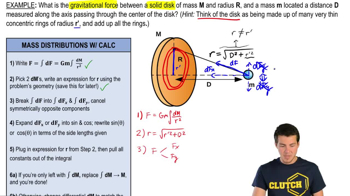
Gravitational Force from a Solid Disk
관련 실천
교과서 질문

A physics professor leaves her house and walks along the sidewalk toward campus. After 55 min, it starts to rain, and she returns home. Her distance from her house as a function of time is shown in Fig. E2.102.10. At which of the labeled points is her velocity constant and positive?

1780
views
교과서 질문

A physics professor leaves her house and walks along the sidewalk toward campus. After 55 min, it starts to rain, and she returns home. Her distance from her house as a function of time is shown in Fig. E2.102.10. At which of the labeled points is her velocity constant and negative?

1221
views
교과서 질문

A race car starts from rest and travels east along a straight and level track. For the first 5.05.0 s of the car's motion, the eastward component of the car's velocity is given by vx(t)=v_{x}(t)= (0.8600.860 m/s3)t2. What is the acceleration of the car when vx=12.0v_{x}=12.0 m/s?

4406
views
2
rank
교과서 질문

A turtle crawls along a straight line, which we will call the xx-axis with the positive direction to the right. The equation for the turtle's position as a function of time is x(t)=50.0x(t) = 50.0 cm + (2.002.00 cm/s)tt − (0.06250.0625 cm/s2)t2t^2. At what time tt is the velocity of the turtle zero?

89
views
교과서 질문

A physics professor leaves her house and walks along the sidewalk toward campus. After 55 min, it starts to rain, and she returns home. Her distance from her house as a function of time is shown in Fig. E2.102.10. At which of the labeled points is her velocity decreasing in magnitude?

1186
views
교과서 질문

A turtle crawls along a straight line, which we will call the xx-axis with the positive direction to the right. The equation for the turtle's position as a function of time is x(t)=50.0x(t) = 50.0 cm + (2.002.00 cm/s)tt − (0.06250.0625 cm/s2)t2t^2. Sketch graphs of xx versus tt, vxv_{x} versus tt, and axa_{x} versus tt, for the time interval t=0t = 0 to t=40t = 40 s.

2010
views