Ch 03: Motion in Two or Three Dimensions
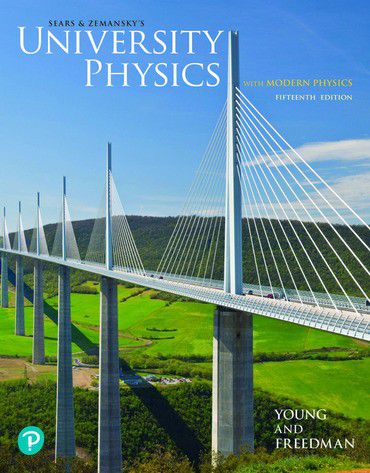
Young & Freedman Calc - University Physics 15th Edition
Young & Freedman Calc15th EditionUniversity PhysicsISBN: 9780135159552당신이 사용하는 게 아니라요?교과서 변경
3장, 문제 33a

At its Ames Research Center, NASA uses its large '20-G' centrifuge to test the effects of very large accelerations ('hypergravity') on test pilots and astronauts. In this device, an arm 8.84 m long rotates about one end in a horizontal plane, and an astronaut is strapped in at the other end. Suppose that he is aligned along the centrifuge's arm with his head at the outermost end. The maximum sustained acceleration to which humans are subjected in this device is typically 12.5g. How fast must the astronaut's head be moving to experience this maximum acceleration?

검증된 단계별 안내
1
Identify the given values: the length of the arm (radius) is 8.84 m, and the maximum acceleration is 12.5g, where g is the acceleration due to gravity (approximately 9.81 m/s²).
Convert the maximum acceleration from g's to m/s² by multiplying 12.5 by 9.81 m/s².
Use the formula for centripetal acceleration, which is given by: a=v2/r, where a is the centripetal acceleration, v is the tangential velocity, and r is the radius.
Rearrange the formula to solve for the velocity v: v=ar.
Substitute the values for a and r into the equation to find the velocity v.

비슷한 문제에 대한 검증된 영상 답변:

이 영상 해법은 위 문제에 도움이 된다고 튜터들이 추천한 것입니다.
영상 길이:
1m
도움이 되었나요?

주요 개념

질문에 올바르게 답하기 위해 반드시 이해해야 하는 핵심 개념들은 다음과 같습니다.

Centripetal Acceleration

Centripetal acceleration is the acceleration experienced by an object moving in a circular path, directed towards the center of the circle. It is given by the formula a = v^2/r, where v is the tangential speed and r is the radius of the circle. Understanding this concept is crucial for calculating the speed required to achieve a specific acceleration in a centrifuge.
추천 영상:
가이드 코스
06:48
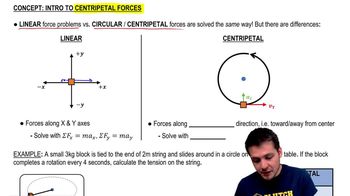
Intro to Centripetal Forces

Gravitational Acceleration (g)

Gravitational acceleration, denoted as g, is the acceleration due to Earth's gravity, approximately 9.81 m/s². In the context of hypergravity, accelerations are often expressed as multiples of g, such as 12.5g, indicating the acceleration is 12.5 times that of Earth's gravity. This helps in understanding the magnitude of forces experienced by astronauts in the centrifuge.
추천 영상:
가이드 코스
07:32
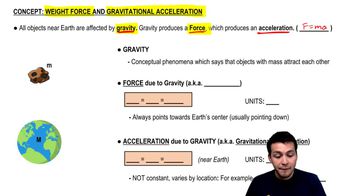
Weight Force & Gravitational Acceleration

Rotational Motion

Rotational motion involves objects moving in a circular path around a central point. Key parameters include angular velocity and tangential speed, which are essential for determining the conditions in a centrifuge. The relationship between linear speed and angular velocity is crucial for calculating the speed needed to achieve a specific centripetal acceleration.
추천 영상:
가이드 코스
07:18
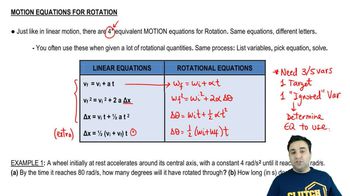
Equations of Rotational Motion
관련 실천
교과서 질문

The earth has a radius of 6380 km and turns around once on its axis in 24 h. If arad at the equator is greater than g, objects will fly off the earth's surface and into space. (We will see the reason for this in Chapter 5.) What would the period of the earth's rotation have to be for this to occur?

4555
views
교과서 질문

At its Ames Research Center, NASA uses its large '20-G' centrifuge to test the effects of very large accelerations ('hypergravity') on test pilots and astronauts. In this device, an arm 8.84 m long rotates about one end in a horizontal plane, and an astronaut is strapped in at the other end. Suppose that he is aligned along the centrifuge's arm with his head at the outermost end. The maximum sustained acceleration to which humans are subjected in this device is typically 12.5g. How fast in rpm (rev/min) is the arm turning to produce the maximum sustained acceleration?

2272
views
교과서 질문

At its Ames Research Center, NASA uses its large '20-G' centrifuge to test the effects of very large accelerations ('hypergravity') on test pilots and astronauts. In this device, an arm 8.84 m long rotates about one end in a horizontal plane, and an astronaut is strapped in at the other end. Suppose that he is aligned along the centrifuge's arm with his head at the outermost end. The maximum sustained acceleration to which humans are subjected in this device is typically 12.5g. What is the difference between the acceleration of his head and feet if the astronaut is 2.00 m tall?

4232
views
2
rank
1
comments
교과서 질문

A model of a helicopter rotor has four blades, each 3.40 m long from the central shaft to the blade tip. The model is rotated in a wind tunnel at 550 rev/min. What is the radial acceleration of the blade tip expressed as a multiple of g?

2074
views
교과서 질문

A model of a helicopter rotor has four blades, each 3.40 m long from the central shaft to the blade tip. The model is rotated in a wind tunnel at 550 rev/min. What is the linear speed of the blade tip, in m/s?

4040
views
교과서 질문

A 'moving sidewalk' in an airport terminal moves at 1.0 m/s and is 35.0 m long. If a woman steps on at one end and walks at 1.5 m/s relative to the moving sidewalk, how much time does it take her to reach the opposite end if she walks in the same direction the sidewalk is moving?

2204
views