Ch 04: Newton's Laws of Motion
Young & Freedman Calc - University Physics 15th Edition
Young & Freedman Calc15th EditionUniversity PhysicsISBN: 9780135159552당신이 사용하는 게 아니라요?교과서 변경
4장, 문제 16a

An astronaut's pack weighs 17.517.5 N when she is on the earth but only 3.243.24 N when she is at the surface of a moon. What is the acceleration due to gravity on this moon?

검증된 단계별 안내
1
Step 1: Recall the relationship between weight and gravitational force. Weight is given by the formula: W = mg, where W is the weight, m is the mass, and g is the acceleration due to gravity.
Step 2: Use the weight of the pack on Earth to calculate its mass. On Earth, the acceleration due to gravity is approximately 9.8 \, \(\text{m/s}\)^2. Rearrange the formula to solve for mass: m = $\frac{W}{g}$. Substitute W = 17.5 \, \(\text{N}\) and g = 9.8 \, \(\text{m/s}\)^2.
Step 3: Once the mass is determined, use the weight of the pack on the moon to find the moon's gravitational acceleration. Rearrange the weight formula to solve for g: g = $\frac{W}{m}$. Substitute W = 3.24 \, \(\text{N}\) and the mass calculated in Step 2.
Step 4: Perform the division to calculate the acceleration due to gravity on the moon. Ensure the units are consistent, and the result is expressed in \(\text{m/s}\)^2.
Step 5: Interpret the result. The calculated value represents the acceleration due to gravity on the moon's surface, which is significantly smaller than Earth's due to the moon's lower mass and size.

비슷한 문제에 대한 검증된 영상 답변:

이 영상 해법은 위 문제에 도움이 된다고 튜터들이 추천한 것입니다.
영상 길이:
1m

주요 개념

질문에 올바르게 답하기 위해 반드시 이해해야 하는 핵심 개념들은 다음과 같습니다.

Weight and Gravitational Force

Weight is the force exerted by gravity on an object, calculated as the product of mass and the acceleration due to gravity (W = mg). On Earth, this acceleration is approximately 9.81 m/s², but it varies on different celestial bodies, affecting the weight of objects.
추천 영상:
가이드 코스
07:32
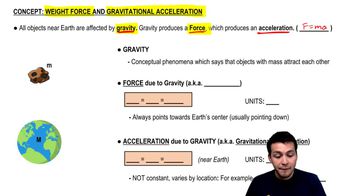
Weight Force & Gravitational Acceleration

Acceleration due to Gravity

The acceleration due to gravity (g) is the rate at which an object accelerates towards a celestial body due to gravitational pull. It varies depending on the mass and radius of the body; for example, the moon has a lower g than Earth, resulting in lighter weights for the same mass.
추천 영상:
가이드 코스
05:20
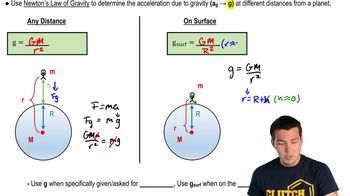
Acceleration Due to Gravity

Newton's Second Law of Motion

Newton's Second Law states that the force acting on an object is equal to the mass of that object multiplied by its acceleration (F = ma). This principle is essential for calculating the acceleration due to gravity on the moon by rearranging the weight equation to find g when the weight and mass are known.
추천 영상:
가이드 코스
06:54
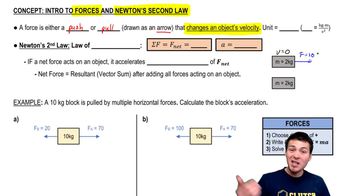
Intro to Forces & Newton's Second Law
관련 실천
교과서 질문

At the surface of Jupiter's moon Io, the acceleration due to gravity is g=1.81g = 1.81 m/s2. A watermelon weighs 44.044.0 N at the surface of the earth. What is the watermelon's mass on the earth's surface?

2391
views
교과서 질문

A 4.504.50-kg experimental cart undergoes an acceleration in a straight line (the xx-axis). The graph in Fig. E4.134.13 shows this acceleration as a function of time. During what times is the net force on the cart a constant?

1784
views
교과서 질문

A small 8.008.00-kg rocket burns fuel that exerts a time-varying upward force on the rocket (assume constant mass) as the rocket moves upward from the launch pad. This force obeys the equation F=A+Bt2F=A+Bt^2. Measurements show that at t=0t = 0, the force is 100.0100.0 N, and at the end of the first 2.002.00 s, it is 150.0150.0 N. Find the constants AA and BB, including their SI units.

3334
views
교과서 질문

A 4.504.50-kg experimental cart undergoes an acceleration in a straight line (the xx-axis). The graph in Fig. E4.134.13 shows this acceleration as a function of time. Find the maximum net force on this cart. When does this maximum force occur?

3283
views
교과서 질문

At the surface of Jupiter's moon Io, the acceleration due to gravity is g=1.81g = 1.81 m/s2. A watermelon weighs 44.044.0 N at the surface of the earth. What would be its mass and weight on the surface of Io?

5445
views
교과서 질문

World-class sprinters can accelerate out of the starting blocks with an acceleration that is nearly horizontal and has magnitude 1515 m/s2. How much horizontal force must a 55 55-kg sprinter exert on the starting blocks to produce this acceleration? Which body exerts the force that propels the sprinter: the blocks or the sprinter herself?

4038
views