
Ch 05: Applying Newton's Laws
Young & Freedman Calc - University Physics 15th Edition
Young & Freedman Calc15th EditionUniversity PhysicsISBN: 9780135159552당신이 사용하는 게 아니라요?교과서 변경
5장, 문제 10a

A 550550-N physics student stands on a bathroom scale in an elevator that is supported by a cable. The combined mass of student plus elevator is 850850 kg. As the elevator starts moving, the scale reads 450450 N. Find the acceleration of the elevator (magnitude and direction).

검증된 단계별 안내
1
Step 1: Identify the forces acting on the student. The forces include the gravitational force (weight) acting downward, which is given as 550 N, and the normal force exerted by the scale, which is given as 450 N. The difference between these forces will help determine the net force acting on the student.
Step 2: Use Newton's second law of motion, \( F_{net} = ma \), to relate the net force to the acceleration. The net force \( F_{net} \) can be calculated as \( F_{net} = F_{scale} - F_{gravity} \), where \( F_{scale} \) is the reading on the scale (450 N) and \( F_{gravity} \) is the weight of the student (550 N).
Step 3: Calculate the net force acting on the student using \( F_{net} = F_{scale} - F_{gravity} \). Substitute the given values: \( F_{net} = 450 \, \text{N} - 550 \, \text{N} \). This will give the net force acting on the student.
Step 4: Determine the acceleration of the elevator using \( a = \frac{F_{net}}{m} \). The mass of the student can be calculated using \( m = \frac{F_{gravity}}{g} \), where \( g \) is the acceleration due to gravity (approximately \( 9.8 \, \text{m/s}^2 \)). Substitute the values to find the mass of the student and then calculate the acceleration.
Step 5: Analyze the direction of the acceleration. If the scale reading is less than the gravitational force, the elevator is accelerating downward. If the scale reading is greater, the elevator is accelerating upward. In this case, since the scale reading is 450 N (less than 550 N), the elevator is accelerating downward.

비슷한 문제에 대한 검증된 영상 답변:

이 영상 해법은 위 문제에 도움이 된다고 튜터들이 추천한 것입니다.
영상 길이:
3m
도움이 되었나요?

주요 개념

질문에 올바르게 답하기 위해 반드시 이해해야 하는 핵심 개념들은 다음과 같습니다.

Newton's Second Law of Motion

Newton's Second Law states that the force acting on an object is equal to the mass of that object multiplied by its acceleration (F = ma). This principle is crucial for analyzing the forces acting on the student and the elevator, allowing us to determine the net force and subsequently the acceleration of the system.
추천 영상:
가이드 코스
06:54
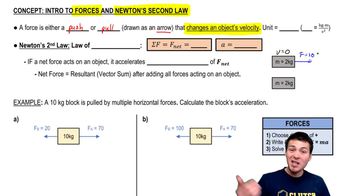
Intro to Forces & Newton's Second Law

Weight and Normal Force

Weight is the force exerted by gravity on an object, calculated as the mass of the object multiplied by the acceleration due to gravity (W = mg). The normal force is the support force exerted by a surface, which in this case is the reading on the scale. Understanding the relationship between weight and normal force is essential for interpreting the scale's reading when the elevator accelerates.
추천 영상:
가이드 코스
08:17
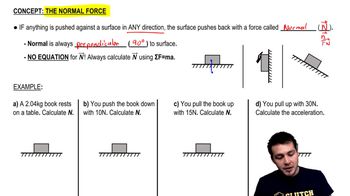
The Normal Force

Free Body Diagram

A free body diagram is a visual representation that shows all the forces acting on an object. In this scenario, drawing a free body diagram for the student in the elevator helps to identify the forces at play, including gravitational force and the normal force from the scale, which are necessary for calculating the elevator's acceleration.
추천 영상:
가이드 코스
08:42
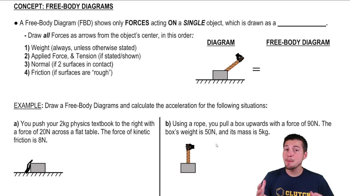
Free-Body Diagrams
관련 실천
교과서 질문

A man pushes on a piano with mass 180180 kg; it slides at constant velocity down a ramp that is inclined at 19.0°19.0° above the horizontal floor. Neglect any friction acting on the piano. Calculate the magnitude of the force applied by the man if he pushes parallel to the incline.

2008
views
교과서 질문

A man pushes on a piano with mass 180180 kg; it slides at constant velocity down a ramp that is inclined at 19.0°19.0° above the horizontal floor. Neglect any friction acting on the piano. Calculate the magnitude of the force applied by the man if he pushes parallel to the floor.

4636
views
교과서 질문

Find the tension in each cord in Fig. E5.75.7 if the weight of the suspended object is ww.

7459
views
교과서 질문

On September 8, 2004, the Genesis spacecraft crashed in the Utah desert because its parachute did not open. The 210210-kg capsule hit the ground at 311311 km/h and penetrated the soil to a depth of 81.081.0 cm. What was its acceleration (in m/s2 and in g's), assumed to be constant, during the crash?

1585
views
교과서 질문

An astronaut is inside a 2.25×1062.25 × 10^6 kg rocket that is blasting off vertically from the launch pad. You want this rocket to reach the speed of sound (331331 m/s) as quickly as possible, but astronauts are in danger of blacking out at an acceleration greater than 4g4g. What is the maximum initial thrust this rocket's engines can have but just barely avoid blackout? Start with a free-body diagram of the rocket.

2499
views
1
rank
교과서 질문

An astronaut is inside a 2.25×1062.25 × 10^6 kg rocket that is blasting off vertically from the launch pad. You want this rocket to reach the speed of sound (331331 m/s) as quickly as possible, but astronauts are in danger of blacking out at an acceleration greater than 4g4g. What force, in terms of the astronaut's weight ww, does the rocket exert on her? Start with a free-body diagram of the astronaut.

2944
views
1
rank