Ch 05: Applying Newton's Laws
Young & Freedman Calc - University Physics 15th Edition
Young & Freedman Calc15th EditionUniversity PhysicsISBN: 9780135159552당신이 사용하는 게 아니라요?교과서 변경
5장, 문제 14b

Three sleds are being pulled horizontally on frictionless horizontal ice using horizontal ropes (Fig. E5.145.14). The pull is of magnitude 190190 N. Find the tension in ropes AA and BB.
Three sleds of different weights (30 kg, 20 kg, 10 kg) are being pulled horizontally on ice with a force indicated.

검증된 단계별 안내
1
Step 1: Identify the forces acting on the sleds. The pull force of 190 N acts horizontally to the right, and the tension in ropes A and B transmits this force between the sleds. Since the ice is frictionless, there is no opposing force due to friction.
Step 2: Calculate the total mass of the system. Add the masses of all three sleds: \( m_{total} = m_1 + m_2 + m_3 \). Using MathML: mtotal=30+20+10
Step 3: Determine the acceleration of the system. Use Newton's second law \( F = ma \) to find the acceleration \( a \). Rearrange to \( a = F / m_{total} \). Using MathML: a=Fmtotal
Step 4: Calculate the tension in rope A. Rope A is responsible for pulling the second and third sleds (20 kg + 10 kg). Use Newton's second law \( T_A = (m_2 + m_3) \cdot a \). Using MathML: TA=(m2+m3)a
Step 5: Calculate the tension in rope B. Rope B is responsible for pulling only the third sled (30 kg). Use Newton's second law \( T_B = m_3 \cdot a \). Using MathML: TB=m3a

비슷한 문제에 대한 검증된 영상 답변:

이 영상 해법은 위 문제에 도움이 된다고 튜터들이 추천한 것입니다.
영상 길이:
7m
도움이 되었나요?

주요 개념

질문에 올바르게 답하기 위해 반드시 이해해야 하는 핵심 개념들은 다음과 같습니다.

Newton's Second Law of Motion

Newton's Second Law states that the acceleration of an object is directly proportional to the net force acting on it and inversely proportional to its mass. This relationship is expressed by the equation F = ma, where F is the net force, m is the mass, and a is the acceleration. In this scenario, understanding how the total force of 190 N affects the sleds' acceleration is crucial for calculating the tensions in the ropes.
추천 영상:
가이드 코스
06:54
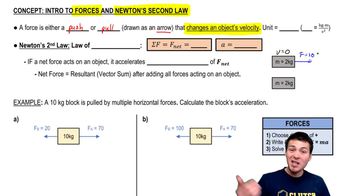
Intro to Forces & Newton's Second Law

Tension in Ropes

Tension is the force transmitted through a rope or string when it is pulled tight by forces acting from opposite ends. In this problem, the tension in ropes A and B must be calculated based on the forces acting on the sleds they connect. The tension will vary depending on the mass of the sleds and the acceleration they experience due to the applied force.
추천 영상:
가이드 코스
06:34
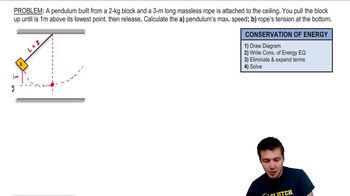
Calculating Tension in a Pendulum with Energy Conservation

System of Connected Objects

When analyzing a system of connected objects, such as the sleds in this problem, it is essential to consider the entire system's mass and the forces acting on each individual object. By applying Newton's laws to the system as a whole and to each sled separately, one can derive equations that relate the tensions in the ropes to the total force and the masses of the sleds, allowing for the calculation of unknown tensions.
추천 영상:
가이드 코스
05:48
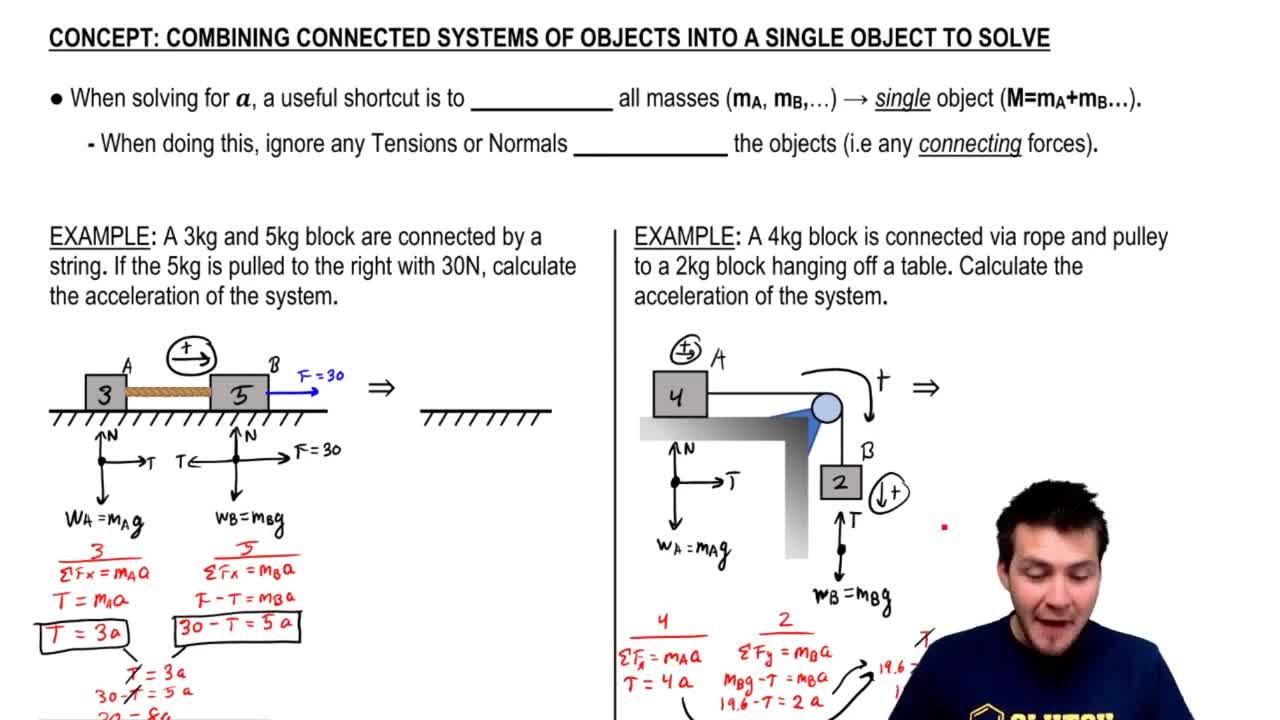
Shortcut for Solving Connected Systems of Objects
관련 실천
교과서 질문

Three sleds are being pulled horizontally on frictionless horizontal ice using horizontal ropes (Fig. E5.145.14). The pull is of magnitude 190190 N. Find the acceleration of the system.

2429
views
교과서 질문

An 8.008.00-kg block of ice, released from rest at the top of a 1.501.50-m-long frictionless ramp, slides downhill, reaching a speed of 2.502.50 m/s at the bottom. What is the angle between the ramp and the horizontal?

3813
views
교과서 질문

An 8.008.00-kg block of ice, released from rest at the top of a 1.501.50-m-long frictionless ramp, slides downhill, reaching a speed of 2.502.50 m/s at the bottom. What would be the speed of the ice at the bottom if the motion were opposed by a constant friction force of 10.010.0 N parallel to the surface of the ramp?

1477
views
교과서 질문

On September 8, 2004, the Genesis spacecraft crashed in the Utah desert because its parachute did not open. The 210210-kg capsule hit the ground at 311311 km/h and penetrated the soil to a depth of 81.081.0 cm. What was its acceleration (in m/s2 and in g's), assumed to be constant, during the crash?

1585
views
교과서 질문

On September 8, 2004, the Genesis spacecraft crashed in the Utah desert because its parachute did not open. The 210210-kg capsule hit the ground at 311311 km/h and penetrated the soil to a depth of 81.081.0 cm. What force did the ground exert on the capsule during the crash? Express the force in newtons and as a multiple of the capsule's weight.

2675
views
교과서 질문

A light rope is attached to a block with mass 4.004.00 kg that rests on a frictionless, horizontal surface. The horizontal rope passes over a frictionless, massless pulley, and a block with mass mm is suspended from the other end. When the blocks are released, the tension in the rope is 15.015.0 N. Draw two free-body diagrams: one for each block.

4175
views