Ch 12: Fluid Mechanics
Young & Freedman Calc - University Physics 15th Edition
Young & Freedman Calc15th EditionUniversity PhysicsISBN: 9780135159552당신이 사용하는 게 아니라요?교과서 변경
12장, 문제 26

A rock has mass 1.80 kg. When the rock is suspended from the lower end of a string and totally immersed in water, the tension in the string is 12.8 N. What is the smallest density of a liquid in which the rock will float?

검증된 단계별 안내
1
Identify the forces acting on the rock when it is immersed in water: the gravitational force (weight), the buoyant force, and the tension in the string.
Use the formula for gravitational force: \( F_g = m \cdot g \), where \( m = 1.80 \text{ kg} \) and \( g = 9.81 \text{ m/s}^2 \). Calculate \( F_g \).
Apply the principle of buoyancy: the buoyant force \( F_b \) is equal to the weight of the displaced water. The tension in the string \( T \) is given as 12.8 N. Use the equation \( F_g = F_b + T \) to find the buoyant force.
The buoyant force can also be expressed as \( F_b = \rho_{water} \cdot V \cdot g \), where \( \rho_{water} \) is the density of water and \( V \) is the volume of the rock. Rearrange to find the volume \( V \) of the rock.
To find the smallest density of a liquid in which the rock will float, set the buoyant force equal to the gravitational force: \( \rho_{liquid} \cdot V \cdot g = F_g \). Solve for \( \rho_{liquid} \) using the volume \( V \) found in the previous step.

비슷한 문제에 대한 검증된 영상 답변:

이 영상 해법은 위 문제에 도움이 된다고 튜터들이 추천한 것입니다.
영상 길이:
8m

주요 개념

질문에 올바르게 답하기 위해 반드시 이해해야 하는 핵심 개념들은 다음과 같습니다.

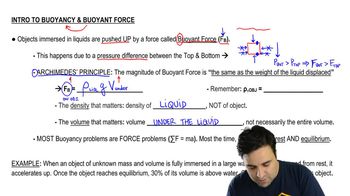
Buoyancy

Buoyancy is the upward force exerted by a fluid on an object submerged in it. This force is equal to the weight of the fluid displaced by the object. Understanding buoyancy is crucial for determining whether an object will float or sink in a fluid, as it directly affects the net force acting on the object.
추천 영상:
가이드 코스
11:06
Intro to Buoyancy & Buoyant Force

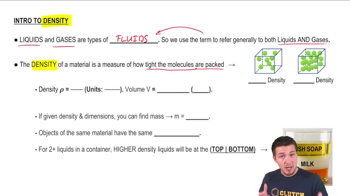
Density

Density is defined as mass per unit volume and is a key factor in determining whether an object will float in a fluid. An object will float if its density is less than the density of the fluid it is placed in. Calculating the density of the rock and comparing it to the fluid's density helps determine the conditions for flotation.
추천 영상:
가이드 코스
8:13
Intro to Density

Archimedes' Principle

Archimedes' Principle states that the buoyant force on an object submerged in a fluid is equal to the weight of the fluid displaced by the object. This principle is essential for solving problems related to flotation and helps in calculating the tension in the string when the rock is immersed, as well as determining the conditions for the rock to float in a different liquid.
추천 영상:
가이드 코스
14:47
Diffraction with Huygen's Principle
관련 실천
교과서 질문

An ore sample weighs 17.50 N in air. When the sample is suspended by a light cord and totally immersed in water, the tension in the cord is 11.20 N. Find the total volume and the density of the sample.

3221
views

교과서 질문

BIO. The lower end of a long plastic straw is immersed below the surface of the water in a plastic cup. An average person sucking on the upper end of the straw can pull water into the straw to a vertical height of 1.1 m above the surface of the water in the cup. (a) What is the lowest gauge pressure that the average person can achieve inside his lungs? (b) Explain why your answer in part (a) is negative.

3037
views
교과서 질문

A slab of ice floats on a freshwater lake. What minimum volume must the slab have for a 65.0-kg woman to be able to stand on it without getting her feet wet?

2993
views
1
rank
교과서 질문

BIO. There is a maximum depth at which a diver can breathe through a snorkel tube (Fig. E12.17) because as the depth increases, so does the pressure difference, which tends to collapse the diver's lungs. Since the snorkel connects the air in the lungs to the atmosphere at the surface, the pressure inside the lungs is atmospheric pressure. What is the external– internal pressure difference when the diver's lungs are at a depth of 6.1 m (about 20 ft)? Assume that the diver is in fresh-water. (A scuba diver breathing from compressed air tanks can operate at greater depths than can a snorkeler, since the pressure of the air inside the scuba diver's lungs increases to match the external pressure of the water.)


3511
views
교과서 질문

Hydraulic Lift II.The piston of a hydraulic automobile lift is 0.30 m in diameter. What gauge pressure, in pascals, is required to lift a car with a mass of 1200 kg? Also express this pressure in atmospheres.

2108
views
1
rank
교과서 질문

A 950-kg cylindrical can buoy floats vertically in sea-water. The diameter of the buoy is 0.900 m. Calculate the additional distance the buoy will sink when an 80.0-kg man stands on top of it.

2786
views
1
rank