
교과서 질문
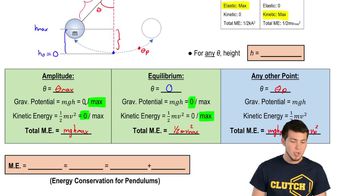
A certain simple pendulum has a period on the earth of 1.60 s. What is its period on the surface of Mars, where g = 3.71 m/s2?
2144
views
 검증된 단계별 안내

 07:52
07:52
 06:53
06:53 05:08
05:08A certain simple pendulum has a period on the earth of 1.60 s. What is its period on the surface of Mars, where g = 3.71 m/s2?
You pull a simple pendulum 0.240 m long to the side through an angle of 3.50° and release it. How much time does it take the pendulum bob to reach its highest speed?
You pull a simple pendulum 0.240 m long to the side through an angle of 3.50° and release it. How much time does it take if the pendulum is released at an angle of 1.75° instead of 3.50°?
A thrill-seeking cat with mass 4.00 kg is attached by a harness to an ideal spring of negligible mass and oscillates vertically in SHM. The amplitude is 0.050 m, and at the highest point of the motion the spring has its natural unstretched length. Calculate the elastic potential energy of the spring (take it to be zero for the unstretched spring), the kinetic energy of the cat, the gravitational potential energy of the system relative to the lowest point of the motion, and the sum of these three energies when the cat is at its highest point.