
Ch 16: Sound & Hearing
Young & Freedman Calc - University Physics 15th Edition
Young & Freedman Calc15th EditionUniversity PhysicsISBN: 9780135159552당신이 사용하는 게 아니라요?교과서 변경
16장, 문제 46a

A railroad train is traveling at 30.0 m/s in still air. The frequency of the note emitted by the train whistle is 352 Hz. What frequency is heard by a passenger on a train moving in the opposite direction to the first at 18.0 m/s and approaching the first?

검증된 단계별 안내
1
Identify the scenario as a Doppler effect problem, where the frequency of a sound changes due to the relative motion between the source and the observer.
Use the Doppler effect formula for sound: fofs=v+vov+vs, where fo is the observed frequency, fs is the source frequency, v is the speed of sound in air (approximately 343 m/s), vo is the speed of the observer, and vs is the speed of the source.
Determine the direction of motion: Since the observer (passenger) is moving towards the source (train), vo is positive, and vs is negative because the source is moving away from the observer.
Substitute the given values into the Doppler effect formula: fo352=343+18343-30.
Solve the equation to find the observed frequency fo.

비슷한 문제에 대한 검증된 영상 답변:

이 영상 해법은 위 문제에 도움이 된다고 튜터들이 추천한 것입니다.
영상 길이:
4m

주요 개념

질문에 올바르게 답하기 위해 반드시 이해해야 하는 핵심 개념들은 다음과 같습니다.

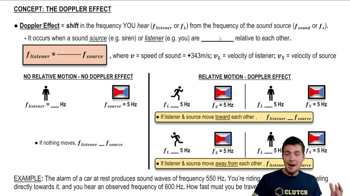
Doppler Effect

The Doppler Effect refers to the change in frequency or wavelength of a wave in relation to an observer moving relative to the wave source. In this scenario, as the trains move towards each other, the frequency of the sound waves increases for the observer, resulting in a higher pitch being heard.
추천 영상:
가이드 코스
07:40
The Doppler Effect

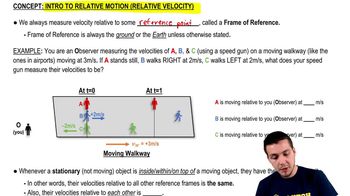
Relative Velocity

Relative velocity is the velocity of an object as observed from a particular reference frame, and it is crucial in calculating the observed frequency in the Doppler Effect. Here, the relative velocity between the two trains affects the frequency heard by the passenger, as it combines the speeds of both trains moving towards each other.
추천 영상:
가이드 코스
04:27
Intro to Relative Motion (Relative Velocity)

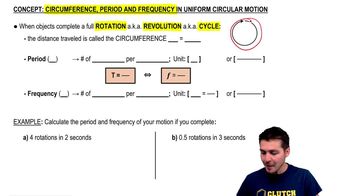
Wave Frequency

Wave frequency is the number of waves that pass a fixed point in unit time, measured in Hertz (Hz). The original frequency of the train whistle is 352 Hz, and understanding how this frequency changes due to the Doppler Effect is essential for determining the frequency heard by the passenger on the opposing train.
추천 영상:
가이드 코스
05:08
Circumference, Period, and Frequency in UCM
관련 실천
교과서 질문

The siren of a fire engine that is driving northward at 30.0 m/s emits a sound of frequency 2000 Hz. A truck in front of this fire engine is moving northward at 20.0 m/s. What wavelength would this driver measure for these reflected sound waves?

1954
views
교과서 질문

A railroad train is traveling at 30.0 m/s in still air. The frequency of the note emitted by the train whistle is 352 Hz. What frequency is heard by a passenger on a train moving in the opposite direction to the first at 18.0 m/s and receding from the first?

1957
views
교과서 질문

Two small stereo speakers are driven in step by the same variable-frequency oscillator. Their sound is picked up by a microphone arranged as shown in Fig. E16.39. For what frequencies does their sound at the speakers produce constructive interference?

2444
views
교과서 질문

Two organ pipes, open at one end but closed at the other, are each 1.14 m long. One is now lengthened by 2.00 cm. Find the beat frequency that they produce when playing together in their fundamentals.

1757
views
교과서 질문

The siren of a fire engine that is driving northward at 30.0 m/s emits a sound of frequency 2000 Hz. A truck in front of this fire engine is moving northward at 20.0 m/s. (a) What is the frequency of the siren's sound that the fire engine's driver hears reflected from the back of the truck?

2811
views
교과서 질문

Two loudspeakers, A and B (Fig. E16.35), are driven by the same amplifier and emit sinusoidal waves in phase. Speaker B is 2.00 m to the right of speaker A. Consider point Q along the extension of the line connecting the speakers, 1.00 m to the right of speaker B. Both speakers emit sound waves that travel directly from the speaker to point Q. What is the lowest frequency for which destructive interference occurs at point Q?

2105
views