
Ch 22: Gauss' Law
Young & Freedman Calc - University Physics 15th Edition
Young & Freedman Calc15th EditionUniversity PhysicsISBN: 9780135159552당신이 사용하는 게 아니라요?교과서 변경
22장, 문제 3

You measure an electric field of 1.25×1061.25\(\times\)10^6 N/C at a distance of 0.1500.150 m from a point charge. There is no other source of electric field in the region other than this point charge.
(a) What is the electric flux through the surface of a sphere that has this charge at its center and that has radius 0.1500.150 m?
(b) What is the magnitude of this charge?

검증된 단계별 안내
1
To solve part (a), recall that the electric flux (Φ) through a closed surface is given by Gauss's Law: Φ = ∮E·dA = Q_enc/ε₀, where E is the electric field, dA is the differential area vector, Q_enc is the enclosed charge, and ε₀ is the permittivity of free space.
Since the electric field is uniform over the surface of the sphere and radial, the flux can be simplified to Φ = E * A, where A is the surface area of the sphere. The surface area of a sphere is A = 4πr², where r is the radius of the sphere.
Substitute the given values into the formula for the surface area: A = 4π(0.150 m)².
Now, calculate the electric flux using Φ = E * A, where E = 1.25×10⁶ N/C and A is the surface area calculated in the previous step.
For part (b), use Gauss's Law to find the magnitude of the charge. Rearrange the formula to solve for Q_enc: Q_enc = Φ * ε₀. Substitute the value of the electric flux from part (a) and the known value of ε₀ (approximately 8.85×10⁻¹² C²/N·m²) to find the charge.

비슷한 문제에 대한 검증된 영상 답변:

이 영상 해법은 위 문제에 도움이 된다고 튜터들이 추천한 것입니다.
영상 길이:
4m

주요 개념

질문에 올바르게 답하기 위해 반드시 이해해야 하는 핵심 개념들은 다음과 같습니다.

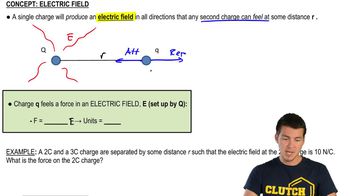
Electric Field

An electric field is a region around a charged particle where a force would be exerted on other charged particles. It is represented by the vector quantity E, measured in newtons per coulomb (N/C). The field's strength and direction depend on the magnitude and sign of the charge creating it, and it diminishes with distance from the charge.
추천 영상:
가이드 코스
03:16
Intro to Electric Fields

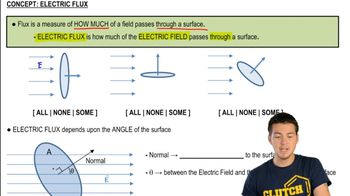
Electric Flux

Electric flux quantifies the amount of electric field passing through a given surface. It is calculated as the product of the electric field and the area perpendicular to the field lines, expressed in units of newton-meters squared per coulomb (N·m²/C). For a sphere surrounding a point charge, the flux is determined using Gauss's Law, which relates the flux to the enclosed charge.
추천 영상:

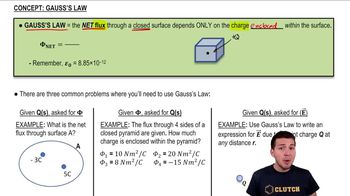
Gauss's Law

Gauss's Law states that the electric flux through a closed surface is proportional to the charge enclosed by the surface. Mathematically, it is expressed as Φ = Q/ε₀, where Φ is the electric flux, Q is the enclosed charge, and ε₀ is the permittivity of free space. This principle is crucial for calculating the electric flux and charge magnitude in symmetrical situations like a sphere surrounding a point charge.
추천 영상:
관련 실천
교과서 질문

A flat sheet of paper of area 0.2500.250 m2 is oriented so that the normal to the sheet is at an angle of 6060° to a uniform electric field of magnitude 1414 N/C. For what angle ϕ\(\phi\) between the normal to the sheet and the electric field is the magnitude of the flux through the sheet (i) largest and (ii) smallest? Explain your answers.

1972
views
1
rank
교과서 질문

The nuclei of large atoms, such as uranium, with 9292 protons, can be modeled as spherically symmetric spheres of charge. The radius of the uranium nucleus is approximately 7.4×10−157.4\(\times\)10^{-15} m. What is the electric field this nucleus produces just outside its surface?

1740
views
1
rank
교과서 질문

A charged paint is spread in a very thin uniform layer over the surface of a plastic sphere of diameter 12.012.0 cm, giving it a charge of −49.0−49.0 μμC. Find the electric field just outside the paint layer;

1947
views
교과서 질문

A flat sheet of paper of area 0.2500.250 m2 is oriented so that the normal to the sheet is at an angle of 6060° to a uniform electric field of magnitude 1414 N/C.

(a) Find the magnitude of the electric flux through the sheet.

(b) Does the answer to part (a) depend on the shape of the sheet? Why or why not?

3216
views
2
rank
교과서 질문

A charged paint is spread in a very thin uniform layer over the surface of a plastic sphere of diameter 12.012.0 cm, giving it a charge of −49.0−49.0 μμC. Find the electric field just inside the paint layer.

2522
views