
Ch 27: Magnetic Field and Magnetic Forces
Young & Freedman Calc - University Physics 15th Edition
Young & Freedman Calc15th EditionUniversity PhysicsISBN: 9780135159552당신이 사용하는 게 아니라요?교과서 변경
27장, 문제 10

A flat, square surface with side length 3.40cm3.40\(\operatorname{cm}\) is in the xy-plane at z=0z = 0. Calculate the magnitude of the flux through this surface produced by a magnetic field B=(0.200T)i+(0.300T)j(0.500T)kB=(0.200T)\(\mathbf{i}\)+(0.300T)\(\mathbf{j}\)-(0.500T)\(\mathbf{k}\).

검증된 단계별 안내
1
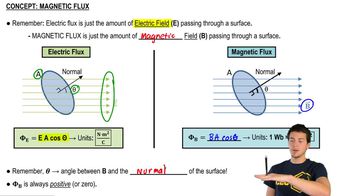
Understand the concept of magnetic flux: Magnetic flux (Φ) through a surface is given by the dot product of the magnetic field vector (B) and the area vector (A). The formula is Φ = B ⋅ A.
Determine the area vector: Since the surface is in the xy-plane, the area vector is perpendicular to the surface and points in the z-direction. The magnitude of the area vector is equal to the area of the surface, and its direction is along the positive z-axis. Therefore, A = (0, 0, A_z).
Calculate the area of the square surface: The side length of the square is 3.40 cm, which needs to be converted to meters for consistency in units. The area (A) of the square is given by A = side_length^2. Convert 3.40 cm to meters by dividing by 100.
Express the area vector: Since the surface is in the xy-plane, the area vector is A = (0, 0, A_z), where A_z is the area calculated in the previous step.
Calculate the dot product B ⋅ A: The magnetic field vector B is given as B = (0.200 T)i + (0.300 T)j - (0.500 T)k. The dot product B ⋅ A is calculated as B_x * A_x + B_y * A_y + B_z * A_z. Since A_x and A_y are zero, the dot product simplifies to B_z * A_z.

비슷한 문제에 대한 검증된 영상 답변:

이 영상 해법은 위 문제에 도움이 된다고 튜터들이 추천한 것입니다.
영상 길이:
4m

주요 개념

질문에 올바르게 답하기 위해 반드시 이해해야 하는 핵심 개념들은 다음과 같습니다.

Magnetic Flux

Magnetic flux through a surface is a measure of the number of magnetic field lines passing through that surface. It is calculated as the dot product of the magnetic field vector and the area vector of the surface. The formula is Φ = B · A = B * A * cos(θ), where B is the magnetic field, A is the area, and θ is the angle between B and the normal to the surface.
추천 영상:

Dot Product

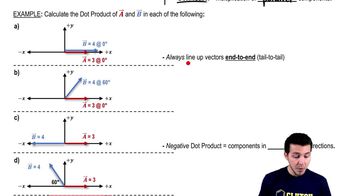
The dot product is a mathematical operation that takes two equal-length sequences of numbers (usually coordinate vectors) and returns a single number. In the context of magnetic flux, it is used to calculate the component of the magnetic field that is perpendicular to the surface. The dot product of vectors A and B is given by A · B = Ax * Bx + Ay * By + Az * Bz.
추천 영상:
가이드 코스
09:07
Introduction to Dot Product (Scalar Product)

Area Vector

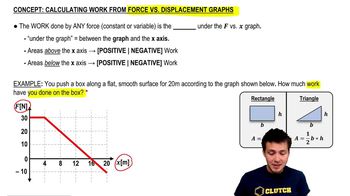
The area vector is a vector that is perpendicular to a given surface and has a magnitude equal to the area of the surface. For a flat surface in the xy-plane, the area vector points in the z-direction. In this problem, the area vector A for the square surface is (0, 0, A), where A is the area of the square, calculated as side length squared.
추천 영상:
가이드 코스
04:05
Calculating Work As Area Under F-x Graphs
관련 실천
교과서 질문

An open plastic soda bottle with an opening diameter of 2.5 cm is placed on a table. A uniform 1.75 T magnetic field directed upward and oriented 25° from vertical encompasses the bottle. What is the total magnetic flux through the plastic of the soda bottle?

2809
views
교과서 질문

A 150 g ball containing 4.00 x 10⁸ excess electrons is dropped into a 125 m vertical shaft. At the bottom of the shaft, the ball suddenly enters a uniform horizontal magnetic field that has magnitude 0.250 T and direction from east to west. If air resistance is negligibly small, find the magnitude and direction of the force that this magnetic field exerts on the ball just as it enters the field.

2089
views
교과서 질문

A particle with mass 1.81×1031.81\(\times\)10^{-3} kg\(\operatorname{kg}\) and a charge of 1.22×10⁸ C1.22\(\times\)10^{-8}\(\text{ C}\) has, at a given instant, a velocity v=(3.00×10⁴ m/s)jv=(3.00\(\times\)10^4\(\text{ m/s}\))\(\mathbf{j}\). What are the magnitude and direction of the particle's acceleration produced by a uniform magnetic field B=(1.63T)i+(0.980T)jB=(1.63T)\(\mathbf{i}\)+(0.980T)\(\mathbf{j}\)?

3743
views
교과서 질문

A horizontal rectangular surface has dimensions 2.80 cm by 3.20 cm and is in a uniform magnetic field that is directed at an angle of 30.0° above the horizontal. What must the magnitude of the magnetic field be to produce a flux of 3.10 x 10⁻⁴ Wb through the surface?

2391
views
교과서 질문

A circular area with a radius of 6.50 cm lies in the xy-plane. What is the magnitude of the magnetic flux through this circle due to a uniform magnetic field B = 0.230 T at an angle of 53.1° from the +z-direction?

2396
views