Ch 33: The Nature and Propagation of Light
Young & Freedman Calc - University Physics 15th Edition
Young & Freedman Calc15th EditionUniversity PhysicsISBN: 9780135159552당신이 사용하는 게 아니라요?교과서 변경
32장, 문제 10

(a) A tank containing methanol has walls 2.50 cm thick made of glass of refractive index 1.550. Light from the outside air strikes the glass at a 41.3° angle with the normal to the glass. Find the angle the light makes with the normal in the methanol. (b) The tank is emptied and refilled with an unknown liquid. If light incident at the same angle as in part (a) enters the liquid in the tank at an angle of 20.2° from the normal, what is the refractive index of the unknown liquid?

검증된 단계별 안내
1
Step 1: Identify the known values for part (a). The refractive index of glass is given as n1 = 1.550, and the angle of incidence in air is θ1 = 41.3°. The refractive index of air is approximately n0 = 1.000.
Step 2: Use Snell's Law to find the angle of refraction in the glass. Snell's Law is given by n0 * sin(θ1) = n1 * sin(θ2), where θ2 is the angle of refraction in the glass. Solve for θ2.
Step 3: Now, apply Snell's Law again to find the angle of refraction in methanol. Let the refractive index of methanol be n2. Use the equation n1 * sin(θ2) = n2 * sin(θ3), where θ3 is the angle of refraction in methanol. Solve for θ3.
Step 4: For part (b), use the given angle of refraction in the unknown liquid, θ4 = 20.2°, and the same angle of incidence in air, θ1 = 41.3°. Apply Snell's Law: n0 * sin(θ1) = n3 * sin(θ4), where n3 is the refractive index of the unknown liquid. Solve for n3.
Step 5: Ensure all angles are in degrees and use a calculator to find the sine values. This will allow you to solve for the unknown angles and refractive indices in each part of the problem.

비슷한 문제에 대한 검증된 영상 답변:

이 영상 해법은 위 문제에 도움이 된다고 튜터들이 추천한 것입니다.
영상 길이:
9m

주요 개념

질문에 올바르게 답하기 위해 반드시 이해해야 하는 핵심 개념들은 다음과 같습니다.

Snell's Law

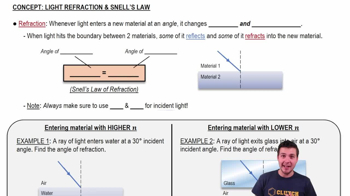
Snell's Law describes how light bends when it passes from one medium to another. It is expressed as n1 * sin(θ1) = n2 * sin(θ2), where n1 and n2 are the refractive indices of the two media, and θ1 and θ2 are the angles of incidence and refraction, respectively. This law is crucial for calculating the angle of refraction when light enters methanol and the unknown liquid.
추천 영상:

Refractive Index

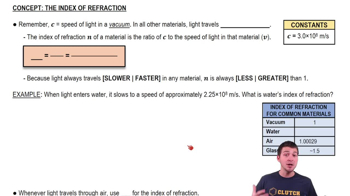
The refractive index of a material quantifies how much light slows down and bends when entering the material. It is defined as the ratio of the speed of light in a vacuum to the speed of light in the material. Understanding refractive indices is essential for determining how light behaves as it transitions from air to glass, then to methanol, and finally to the unknown liquid.
추천 영상:
가이드 코스
03:46
Index of Refraction

Angle of Incidence and Refraction

The angle of incidence is the angle between the incoming light ray and the normal to the surface, while the angle of refraction is the angle between the refracted ray and the normal. These angles are pivotal in applying Snell's Law to find how light bends as it moves through different media, such as glass, methanol, and the unknown liquid in the tank.
추천 영상:
가이드 코스
03:46
Index of Refraction