Ch 36: Diffraction
Young & Freedman Calc - University Physics 15th Edition
Young & Freedman Calc15th EditionUniversity PhysicsISBN: 9780135159552당신이 사용하는 게 아니라요?교과서 변경
35장, 문제 16

Monochromatic light of wavelength 592 nm from a distant source passes through a slit that is 0.0290 mm wide. In the resulting diffraction pattern, the intensity at the center of the central maximum (θ = 0°) is 4.00x10⁻⁵ W/m2. What is the intensity at a point on the screen that corresponds to θ = 1.20°?

검증된 단계별 안내
1
Step 1: Understand the problem. This is a single-slit diffraction problem where the intensity of light at a given angle (u) is calculated using the diffraction formula. The central maximum intensity is given, and we need to find the intensity at u = 1.20°. The wavelength of light (λ), slit width (a), and central intensity (I₀) are provided.
Step 2: Recall the formula for intensity in single-slit diffraction. The intensity at an angle u is given by: I(u) = I₀ * (sin(β)/β)^2, where β = (π * a * sin(u)) / λ. Here, I₀ is the intensity at the center (u = 0°), a is the slit width, λ is the wavelength, and u is the angle.
Step 3: Calculate β using the given values. Substitute the slit width (a = 0.0290 mm = 2.90 × 10⁻⁵ m), wavelength (λ = 592 nm = 5.92 × 10⁻⁷ m), and angle (u = 1.20°). First, convert the angle to radians: u = 1.20° × (π/180). Then, calculate β using the formula β = (π * a * sin(u)) / λ.
Step 4: Compute the term (sin(β)/β)^2. Once β is determined, calculate sin(β) and divide it by β. Square the result to find (sin(β)/β)^2.
Step 5: Multiply the central intensity (I₀ = 4.00 × 10⁻⁵ W/m²) by (sin(β)/β)^2 to find the intensity at u = 1.20°. This gives the final expression for I(u).

비슷한 문제에 대한 검증된 영상 답변:

이 영상 해법은 위 문제에 도움이 된다고 튜터들이 추천한 것입니다.
영상 길이:
6m
도움이 되었나요?

주요 개념

질문에 올바르게 답하기 위해 반드시 이해해야 하는 핵심 개념들은 다음과 같습니다.

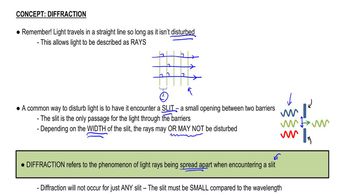
Diffraction

Diffraction is the bending of waves around obstacles and the spreading of waves when they pass through narrow openings. In the context of light, diffraction patterns are created when light waves encounter a slit, leading to regions of constructive and destructive interference. The width of the slit and the wavelength of the light are critical factors that determine the extent of diffraction.
추천 영상:

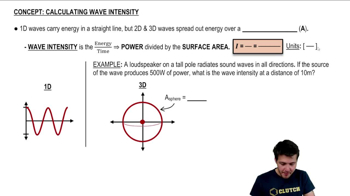
Intensity of Light

The intensity of light refers to the power per unit area carried by a wave, typically measured in watts per square meter (W/m²). In diffraction patterns, intensity varies with angle due to the interference of light waves. The central maximum has the highest intensity, while other points exhibit lower intensities based on their position relative to the central peak.
추천 영상:

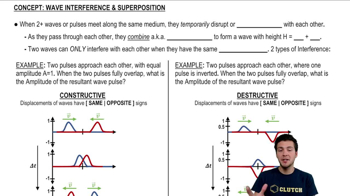
Interference Patterns

Interference patterns arise when two or more coherent light waves overlap, resulting in regions of varying intensity. Constructive interference occurs when waves are in phase, amplifying intensity, while destructive interference occurs when waves are out of phase, reducing intensity. The angle of observation, such as u = 1.20°, plays a crucial role in determining the specific intensity at that point in the diffraction pattern.
추천 영상:
가이드 코스
03:47
Wave Interference & Superposition
관련 실천
교과서 질문

Laser light of wavelength 500.0 nm illuminates two identical slits, producing an interference pattern on a screen 90.0 cm from the slits. The bright bands are 1.00 cm apart, and the third bright bands on either side of the central maximum are missing in the pattern. Find the width and the separation of the two slits.

2071
views
1
rank
교과서 질문

When laser light of wavelength 632.8 nm passes through a diffraction grating, the first bright spots occur at ±17.8° from the central maximum. (a) What is the line density (in lines/cm) of this grating? (b) How many additional bright spots are there beyond the first bright spots, and at what angles do they occur?

383
views
교과서 질문

Parallel rays of monochromatic light with wavelength 568 nm illuminate two identical slits and produce an interference pattern on a screen that is 75.0 cm from the slits. The centers of the slits are 0.640 mm apart and the width of each slit is 0.434 mm. If the intensity at the center of the central maximum is 5.00 x 10⁻⁴ W/m2, what is the intensity at a point on the screen that is 0.900 mm from the center of the central maximum?

2026
views
교과서 질문

A series of parallel linear water wave fronts are traveling directly toward the shore at 15.0 cm/s on an otherwise placid lake. A long concrete barrier that runs parallel to the shore at a distance of 3.20 m away has a hole in it. You count the wave crests and observe that 75.0 of them pass by each minute, and you also observe that no waves reach the shore at ±61.3 cm from the point directly opposite the hole, but waves do reach the shore everywhere within this distance. At what other angles do you find no waves hitting the shore?

1682
views
교과서 질문

A series of parallel linear water wave fronts are traveling directly toward the shore at 15.0 cm/s on an otherwise placid lake. A long concrete barrier that runs parallel to the shore at a distance of 3.20 m away has a hole in it. You count the wave crests and observe that 75.0 of them pass by each minute, and you also observe that no waves reach the shore at ±61.3 cm from the point directly opposite the hole, but waves do reach the shore everywhere within this distance. How wide is the hole in the barrier?

1683
views
교과서 질문

Monochromatic light of wavelength 580 nm passes through a single slit and the diffraction pattern is observed on a screen. Both the source and screen are far enough from the slit for Fraunhofer diffraction to apply. (a) If the first diffraction minima are at ±90.0°, so the central maximum completely fills the screen, what is the width of the slit? (b) For the width of the slit as calculated in part (a), what is the ratio of the intensity at θ = 45.0° to the intensity at θ = 0?

1952
views