Ch 37: Special Relativity
Young & Freedman Calc - University Physics 15th Edition
Young & Freedman Calc15th EditionUniversity PhysicsISBN: 9780135159552당신이 사용하는 게 아니라요?교과서 변경
36장, 문제 37.15

An observer in frame S′ is moving to the right (+x-direction) at speed u = 0.600c away from a stationary observer in frame S. The observer in S′ measures the speed v′ of a particle moving to the right away from her. What speed v does the observer in S measure for the particle if (a) v′ = 0.400c; (b) v′ = 0.900c; (c) v′ = 0.990c?

검증된 단계별 안내
1
Step 1: Recognize that this problem involves relativistic velocity addition. The formula for relativistic velocity transformation is: vS=vS'+u1+vS'uc2, where vS' is the velocity of the particle as measured in frame S′, u is the relative velocity between frames S and S′, and c is the speed of light.
Step 2: Substitute the given values into the formula. For all parts of the problem, u is given as 0.600c. For part (a), vS' is 0.400c. For part (b), vS' is 0.900c. For part (c), vS' is 0.990c. Plug these values into the formula one at a time.
Step 3: Simplify the numerator of the formula for each case. For example, in part (a), the numerator becomes 0.400c+0.600c, which simplifies to 1.000c. Repeat this process for parts (b) and (c).
Step 4: Simplify the denominator of the formula for each case. For part (a), the denominator becomes 1+0.400c×0.600cc2, which simplifies to 1+0.240. Repeat this process for parts (b) and (c).
Step 5: Divide the simplified numerator by the simplified denominator for each case to find the speed vS as measured by the observer in frame S. This step completes the calculation for each part of the problem.

비슷한 문제에 대한 검증된 영상 답변:

이 영상 해법은 위 문제에 도움이 된다고 튜터들이 추천한 것입니다.
영상 길이:
8m
도움이 되었나요?

주요 개념

질문에 올바르게 답하기 위해 반드시 이해해야 하는 핵심 개념들은 다음과 같습니다.

Relativity of Velocity

In the framework of special relativity, the velocity of an object as measured in different inertial frames is not simply additive. Instead, the relativistic velocity addition formula must be used, which accounts for the effects of time dilation and length contraction at speeds close to the speed of light. This formula ensures that the resultant speed never exceeds the speed of light, c.
추천 영상:
가이드 코스
04:27
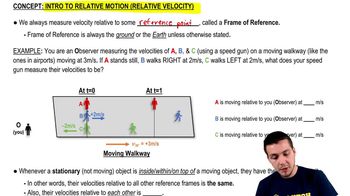
Intro to Relative Motion (Relative Velocity)

Lorentz Transformation

The Lorentz transformation equations relate the space and time coordinates of events as observed in different inertial frames moving relative to each other at a constant velocity. These transformations are essential for converting measurements from one frame to another, particularly when dealing with high velocities, and they incorporate the effects of time dilation and length contraction.
추천 영상:
가이드 코스
13:39
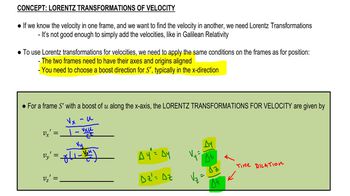
Lorentz Transformations of Velocity

Speed of Light as a Cosmic Speed Limit

According to Einstein's theory of relativity, the speed of light in a vacuum is the ultimate speed limit in the universe, denoted as c. No object with mass can reach or exceed this speed. This principle is fundamental in understanding how velocities combine in relativistic contexts, ensuring that the calculated speeds remain below c, regardless of the relative motion of observers.
추천 영상:
가이드 코스
07:59
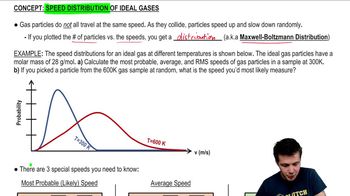
Speed Distribution & Special Speeds of Ideal Gases