Ch 40: Quantum Mechanics I: Wave Functions
Young & Freedman Calc - University Physics 15th Edition
Young & Freedman Calc15th EditionUniversity PhysicsISBN: 9780135159552당신이 사용하는 게 아니라요?교과서 변경
39장, 문제 40.2c

A free particle moving in one dimension has wave function ψ(x,t) = A[e^i(kx-ωt) -e^i(2kx-4ωt)] where k and v are positive real constants. (c) Calculate v_av as the distance the maxima have moved divided by the elapsed time.

검증된 단계별 안내
1
First, identify the wave function given: ψ(x,t) = A[e^(i(kx-ωt)) - e^(i(2kx-4ωt))]. This represents a superposition of two waves with different wave numbers and angular frequencies.
To find the maxima, consider the condition for constructive interference, which occurs when the phase difference between the two waves is an integer multiple of 2π. This means setting the argument of the exponentials equal to each other modulo 2π.
Calculate the phase difference between the two waves: Δφ = (2kx - 4ωt) - (kx - ωt) = kx - 3ωt. Set Δφ = 2πn, where n is an integer, to find the positions of maxima.
Solve for x in terms of t: kx - 3ωt = 2πn implies x = (2πn + 3ωt)/k. This equation gives the position of the maxima as a function of time.
The average velocity v_av of the maxima is the change in position divided by the change in time. Use the expression for x to find v_av: v_av = (d/dt)[(2πn + 3ωt)/k] = 3ω/k.

비슷한 문제에 대한 검증된 영상 답변:

이 영상 해법은 위 문제에 도움이 된다고 튜터들이 추천한 것입니다.
영상 길이:
14m
도움이 되었나요?

주요 개념

질문에 올바르게 답하기 위해 반드시 이해해야 하는 핵심 개념들은 다음과 같습니다.

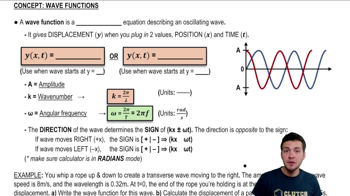
Wave Function

A wave function, denoted as ψ(x,t), describes the quantum state of a particle in terms of its position and time. It contains all the information about the system and is used to calculate probabilities of finding a particle in a particular state. In this context, the wave function is a superposition of two waves, indicating interference effects.
추천 영상:
가이드 코스
08:30
Intro to Wave Functions

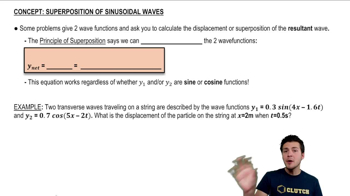
Superposition Principle

The superposition principle states that if two or more wave functions are solutions to a linear wave equation, their sum is also a solution. This principle is crucial in quantum mechanics, as it allows for the combination of multiple states, leading to interference patterns. In the given wave function, the superposition of two waves results in a complex pattern of maxima and minima.
추천 영상:
가이드 코스
03:32
Superposition of Sinusoidal Wave Functions

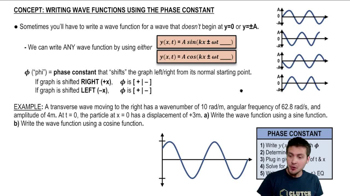
Phase Velocity

Phase velocity is the rate at which the phase of the wave propagates in space. It is given by the formula v_p = ω/k, where ω is the angular frequency and k is the wave number. In the context of the problem, understanding phase velocity helps in determining how the maxima of the wave function move over time, which is essential for calculating the average velocity v_av.
추천 영상:
가이드 코스
08:59
Phase Constant of a Wave Function