Ch 43: Nuclear Physics
Young & Freedman Calc - University Physics 15th Edition
Young & Freedman Calc15th EditionUniversity PhysicsISBN: 9780135159552당신이 사용하는 게 아니라요?교과서 변경
42장, 문제 27

Measurements on a certain isotope tell you that the decay rate decreases from 83188318 decays/min to 30913091 decays/min in 4.004.00 days. What is the half-life of this isotope?

검증된 단계별 안내
1
Identify the given quantities: the initial decay rate \(R_0 = 8318\) decays/min, the final decay rate \(R = 3091\) decays/min after a time interval \(t = 4.00\) days.
Recall that radioactive decay follows an exponential decay law given by \(R = R_0 \times e^{-\lambda t}\), where \(\lambda\) is the decay constant.
Rearrange the decay law to solve for the decay constant \(\lambda\): \(\lambda = -\frac{1}{t} \ln\left(\frac{R}{R_0}\right)\).
Calculate the decay constant \(\lambda\) using the given values of \(R\), \(R_0\), and \(t\) (make sure to convert time \(t\) into consistent units, such as minutes or days, depending on your preference).
Use the relationship between the half-life \(T_{1/2}\) and the decay constant: \(T_{1/2} = \frac{\ln 2}{\lambda}\) to find the half-life of the isotope.

비슷한 문제에 대한 검증된 영상 답변:

이 영상 해법은 위 문제에 도움이 된다고 튜터들이 추천한 것입니다.
영상 길이:
4m
도움이 되었나요?

주요 개념

질문에 올바르게 답하기 위해 반드시 이해해야 하는 핵심 개념들은 다음과 같습니다.

Radioactive Decay and Decay Rate

Radioactive decay is a random process where unstable nuclei lose energy by emitting radiation. The decay rate, or activity, is the number of decays per unit time and decreases exponentially over time as the number of undecayed nuclei diminishes.
추천 영상:
가이드 코스
04:24
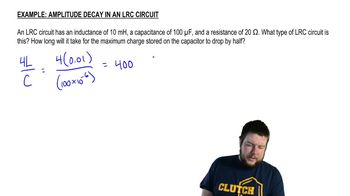
Amplitude Decay in an LRC Circuit

Exponential Decay Law

The exponential decay law describes how the quantity of a radioactive substance decreases over time: N(t) = N0 * e^(-λt), where λ is the decay constant. The decay rate is proportional to the number of undecayed nuclei, so it also follows this exponential decrease.
추천 영상:
가이드 코스
04:24
Amplitude Decay in an LRC Circuit

Half-Life and Decay Constant Relationship

The half-life is the time required for half of the radioactive nuclei to decay. It is related to the decay constant by t½ = ln(2)/λ. Knowing the decay rate at two times allows calculation of λ, and thus the half-life.
추천 영상:
가이드 코스
08:59
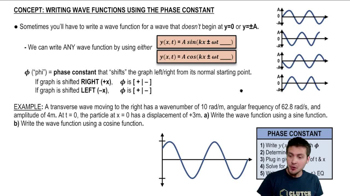
Phase Constant of a Wave Function
관련 실천
교과서 질문

In a diagnostic x-ray procedure, 5.00×10105.00\(\times\)10^{10} photons are absorbed by tissue with a mass of 0.6000.600 kg. The x-ray wavelength is 0.0200 0.0200 nm.

(a) What is the total energy absorbed by the tissue?

(b) What is the equivalent dose in rem?

1353
views
교과서 질문

What particle (a particle, electron, or positron) is emitted in the following radioactive decays?

(a) 1427Si1327Al_{14}^{27}Si\(\rightarrow\)_{13}^{27}Al

(b) 92238U90234Th_{92}^{238}U\(\rightarrow\)_{90}^{234}Th

(c) 3374As3474Se_{33}^{74}As\(\rightarrow\)_{34}^{74}Se

1382
views
교과서 질문

Radioactive isotopes used in cancer therapy have a 'shelf-life,' like pharmaceuticals used in chemotherapy. Just after it has been manufactured in a nuclear reactor, the activity of a sample of 60Co^{60}Co is 50005000 Ci. When its activity falls below 35003500 Ci, it is considered too weak a source to use in treatment. You work in the radiology department of a large hospital. One of these 60Co^{60}Co sources in your inventory was manufactured on October 6, 2011. It is now April 6, 2014. Is the source still usable? The half-life of 60Co^{60}Co is 5.2715.271 years.

1776
views
교과서 질문

The common isotope of uranium, 238U^{238}U, has a half-life of 4.47×1094.47\(\times\)10^9 years, decaying to 234Th^{234}Th by alpha emission.

(a) What is the decay constant?

(b) What mass of uranium is required for an activity of 1.001.00 curie?

(c) How many alpha particles are emitted per second by 10.010.0 g of uranium?

1701
views
교과서 질문

It has become popular for some people to have yearly whole-body scans (CT scans, formerly called CAT scans) using x rays, just to see if they detect anything suspicious. A number of medical people have recently questioned the advisability of such scans, due in part to the radiation they impart. Typically, one such scan gives a dose of 1212 mSv, applied to the whole body. By contrast, a chest x ray typically administers 0.200.20 mSv to only 5.05.0 kg of tissue. How many chest x rays would deliver the same total amount of energy to the body of a 7575-kg person as one whole-body scan?

1297
views
교과서 질문

At an archeological site, a sample from timbers containing 500500 g of carbon provides 26902690 decays/min. What is the age of the sample?

1144
views