Skip to main content
Precalculus
나의 코스
배우기
시험 준비
AI 튜터
학습 가이드
플래시카드
탐험해 보세요
앱을 사용해 보세요
나의 코스
배우기
시험 준비
AI 튜터
학습 가이드
플래시카드
탐험해 보세요
앱을 사용해 보세요
뒤로
Arithmetic Sequences quiz
카드를 뒤집기 위해 탭할 수 있습니다.
What is the defining characteristic of an arithmetic sequence?
카드를 뒤집기 위해 탭할 수 있습니다.
👆
What is the defining characteristic of an arithmetic sequence?
An arithmetic sequence has a constant difference between consecutive terms, called the common difference.
진행 상황 추적
컨트롤 버튼이 '내비게이션' 모드로 변경되었습니다.
1/15
관련 플래시카드
관련 실천
추천 영상
Arithmetic Sequences definitions
Arithmetic Sequences
15 용어
Arithmetic Sequences
20. Sequences, Series & Induction
4 문제점
주제
Geometric Sequences
20. Sequences, Series & Induction
6 문제점
주제
20. Sequences, Series & Induction
3 주제
6 문제점
장
02:35
Example 1
365
views
10
rank
05:17
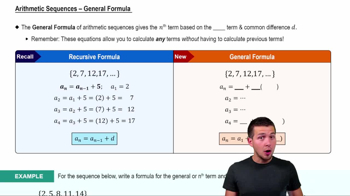
Arithmetic Sequences - General Formula
460
views
10
rank
07:00
Example 2
340
views
14
rank
이 집합의 용어 (15)
하이드의 정의
What is the defining characteristic of an arithmetic sequence?
An arithmetic sequence has a constant difference between consecutive terms, called the common difference.
What symbol is commonly used to represent the common difference in an arithmetic sequence?
The common difference is usually represented by the lowercase letter 'd'.
How do you write the recursive formula for an arithmetic sequence?
The recursive formula is a_n = a_(n-1) + d, where d is the common difference.
Why must you specify the first term when using a recursive formula for an arithmetic sequence?
You must specify the first term because the recursive formula needs a starting value to generate subsequent terms.
How do you find the common difference in a sequence of numbers?
Subtract any term from the next term in the sequence; the result is the common difference.
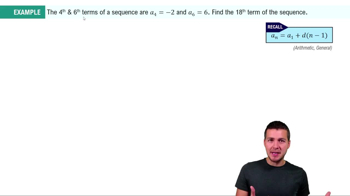
What is the general formula for the nth term of an arithmetic sequence?
The general formula is a_n = a_1 + d*(n-1), where a_1 is the first term and d is the common difference.
How would you use the general formula to find the 101st term of an arithmetic sequence?
Plug n = 101 into the general formula: a_101 = a_1 + d*(101-1).
What is the common difference in the sequence 2, 7, 12, 17?
The common difference is 5, since each term increases by 5.
If a sequence starts at 3 and each term increases by 4, what are the first four terms?
The first four terms are 3, 7, 11, and 15.
What happens if the common difference in an arithmetic sequence is negative?
The sequence decreases by the absolute value of the common difference each time.
How do you write a recursive formula for the sequence 2, 5, 8, 11, 14?
The recursive formula is a_n = a_(n-1) + 3, with a_1 = 2.
What is the purpose of the general formula in arithmetic sequences?
It allows you to find any term in the sequence directly, without calculating all previous terms.
How do you determine if a sequence is arithmetic?
Check if the difference between each pair of consecutive terms is always the same.
In the sequence 9, 3, -3, -9, what is the common difference and recursive formula?
The common difference is -6, and the recursive formula is a_n = a_(n-1) - 6, with a_1 = 9.
Why is it important to subtract the next term minus the previous term when finding the common difference?
Subtracting in this order ensures you get the correct sign for the common difference.
 뒤로뒤로
뒤로뒤로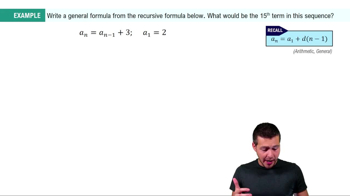
 02:35
02:35