Skip to main content
Precalculus
나의 코스
배우기
시험 준비
AI 튜터
학습 가이드
플래시카드
탐험해 보세요
앱을 사용해 보세요
나의 코스
배우기
시험 준비
AI 튜터
학습 가이드
플래시카드
탐험해 보세요
앱을 사용해 보세요
뒤로
Complementary and Supplementary Angles quiz
카드를 뒤집기 위해 탭할 수 있습니다.
What is the sum of two complementary angles?
카드를 뒤집기 위해 탭할 수 있습니다.
👆
What is the sum of two complementary angles?
The sum of two complementary angles is 90 degrees.
진행 상황 추적
컨트롤 버튼이 '내비게이션' 모드로 변경되었습니다.
1/15
관련 플래시카드
관련 실천
추천 영상
Complementary and Supplementary Angles definitions
Complementary and Supplementary Angles
14 용어
Complementary and Supplementary Angles
7. Measuring Angles
7 문제점
주제
Radians
7. Measuring Angles
3 문제점
주제
7. Measuring Angles
4 주제
8 문제점
장
2:28
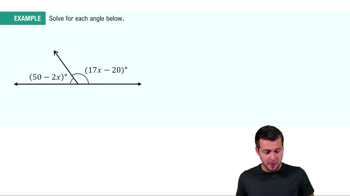
Solving Problems with Complementary & Supplementary Angles
1372
views
59
rank
3:04
Example 1
1234
views
83
rank
3:35
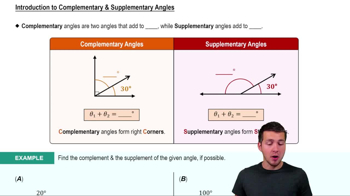
Intro to Complementary & Supplementary Angles
2220
views
60
rank
이 집합의 용어 (15)
하이드의 정의
What is the sum of two complementary angles?
The sum of two complementary angles is 90 degrees.
What is the sum of two supplementary angles?
The sum of two supplementary angles is 180 degrees.
How do you find the complement of a 30-degree angle?
Subtract 30 from 90; the complement is 60 degrees.
How do you find the supplement of a 30-degree angle?
Subtract 30 from 180; the supplement is 150 degrees.
What is the complement of a 20-degree angle?
The complement is 70 degrees, since 90 - 20 = 70.
What is the supplement of a 20-degree angle?
The supplement is 160 degrees, since 180 - 20 = 160.
Does a 100-degree angle have a complement?
No, because its complement would be negative, which is not allowed.
What is the supplement of a 100-degree angle?
The supplement is 80 degrees, since 180 - 100 = 80.
In a right triangle, what is the relationship between the two non-right angles?
The two non-right angles are complementary and add up to 90 degrees.
If two angles are x and x + 10 and are complementary, what equation can you set up?
You can set up the equation x + (x + 10) = 90.
If x + (x + 10) = 90, what is the value of x?
x = 40, since 2x + 10 = 90 leads to 2x = 80, so x = 40.
What are the measures of the two complementary angles if one is x and the other is x + 10?
The angles are 40 degrees and 50 degrees.
What mnemonic can help you remember complementary and supplementary angles?
Complementary angles form corners (C with C), and supplementary angles form straight lines (S with S).
What do you do if an angle is given as a variable and you need to find its complement or supplement?
Set up an equation where the sum equals 90 for complement or 180 for supplement, then solve for the variable.
Why can't angles greater than 90 degrees have a complement?
Because their complement would be negative, which is not a valid angle measure.
 뒤로뒤로
뒤로뒤로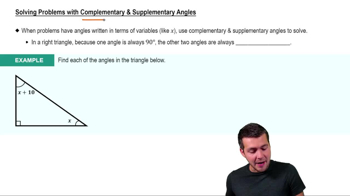
 2:28
2:28