Skip to main content
Precalculus
나의 코스
배우기
시험 준비
AI 튜터
학습 가이드
플래시카드
탐험해 보세요
앱을 사용해 보세요
나의 코스
배우기
시험 준비
AI 튜터
학습 가이드
플래시카드
탐험해 보세요
앱을 사용해 보세요
뒤로
Exponents quiz
카드를 뒤집기 위해 탭할 수 있습니다.
What does 1 raised to any power equal?
카드를 뒤집기 위해 탭할 수 있습니다.
👆
What does 1 raised to any power equal?
1 raised to any power always equals 1, regardless of the exponent.
진행 상황 추적
컨트롤 버튼이 '내비게이션' 모드로 변경되었습니다.
1/15
관련 플래시카드
관련 실천
추천 영상
Exponents definitions
Exponents
15 용어
Exponents
0. Fundamental Concepts of Algebra
3 문제점
주제
Polynomials Intro
0. Fundamental Concepts of Algebra
3 문제점
주제
0. Fundamental Concepts of Algebra
10 주제
10 문제점
장
6:37
Zero and Negative Rules
2128
views
95
rank
5:50
Power Rules
1907
views
74
rank
6:39
Simplifying Exponential Expressions
1647
views
111
rank
2
comments
이 집합의 용어 (15)
하이드의 정의
What does 1 raised to any power equal?
1 raised to any power always equals 1, regardless of the exponent.
What happens to the negative sign when a negative number is raised to an even power?
The negative sign cancels out, so the result is positive.
What is the result of a negative number raised to an odd power?
The result keeps the negative sign, so the answer is negative.
What is the product rule for exponents when multiplying terms with the same base?
You add the exponents together when multiplying terms with the same base.
What is the quotient rule for exponents when dividing terms with the same base?
You subtract the exponent in the denominator from the exponent in the numerator.
What does any nonzero number raised to the zero power equal?
Any nonzero number raised to the zero power equals 1.
What does a negative exponent indicate?
A negative exponent means you take the reciprocal of the base raised to the positive exponent.
How do you simplify (xy)^-3?
You rewrite it as 1 divided by (xy)^3.
How do you simplify x*y^-3 (without parentheses)?
You rewrite it as x divided by y^3.
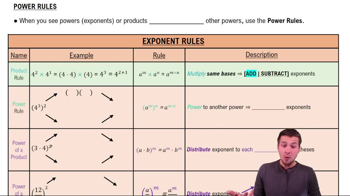
What is the power rule for exponents when you have a power raised to another power?
You multiply the exponents together.
How do you simplify (ab)^n using exponent rules?
You distribute the exponent: (ab)^n = a^n * b^n.
How do you simplify (a/b)^n using exponent rules?
You distribute the exponent: (a/b)^n = a^n / b^n.
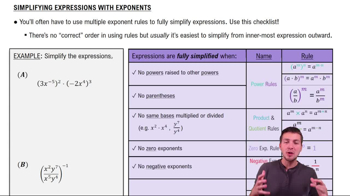
What should you do if you have negative exponents in your final answer?
Rewrite the expression so all exponents are positive by moving terms with negative exponents to the opposite side of the fraction.
What is a systematic approach to simplifying complex exponent expressions?
Check for powers on powers, combine like bases, evaluate numbers, and ensure no negative or zero exponents remain.
When simplifying expressions with multiple exponent rules, what order is usually best?
It's usually best to simplify inside parentheses first and then work outward.
 뒤로뒤로
뒤로뒤로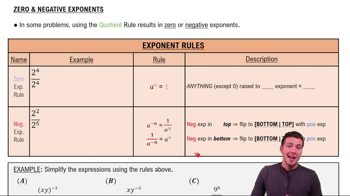
 6:37
6:37