Skip to main content
Precalculus
나의 코스
배우기
시험 준비
AI 튜터
학습 가이드
플래시카드
탐험해 보세요
앱을 사용해 보세요
나의 코스
배우기
시험 준비
AI 튜터
학습 가이드
플래시카드
탐험해 보세요
앱을 사용해 보세요
뒤로
Graphs and Coordinates definitions
8 학생들은 이 점이 도움이 되었다고 느꼈습니다
카드를 뒤집기 위해 탭할 수 있습니다.
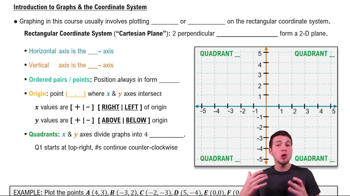
Rectangular Coordinate System
카드를 뒤집기 위해 탭할 수 있습니다.
👆
Rectangular Coordinate System
A two-dimensional grid formed by intersecting horizontal and vertical number lines, used to locate points with ordered pairs.
진행 상황 추적
컨트롤 버튼이 '내비게이션' 모드로 변경되었습니다.
1/15
관련 플래시카드
관련 실천
추천 영상
Graphs and Coordinates quiz
Graphs and Coordinates
15 용어
Graphs and Coordinates
2. Graphs
6 문제점
주제
Two-Variable Equations
2. Graphs
3 문제점
주제
2. Graphs
3 주제
4 문제점
장
02:16
Graphs and Coordinates - Example
3302
views
294
rank
05:10
Graphs & the Rectangular Coordinate System
6994
views
250
rank
1
comments
이 집합의 용어 (15)
하이드의 정의
Rectangular Coordinate System
A two-dimensional grid formed by intersecting horizontal and vertical number lines, used to locate points with ordered pairs.
Cartesian Plane
A plane defined by perpendicular x and y axes, allowing representation of points using two numerical coordinates.
X-Axis
The horizontal reference line in the coordinate system, used to determine the first value in an ordered pair.
Y-Axis
The vertical reference line in the coordinate system, used to determine the second value in an ordered pair.
Origin
The intersection point of the x and y axes, serving as the reference (0, 0) for all other locations on the grid.
Ordered Pair
A notation (x, y) representing a specific location on the plane, with the first value for x and the second for y.
Coordinate
A numerical value indicating a position along either the x or y axis within the plane.
Quadrant
One of four regions into which the axes divide the plane, each with distinct combinations of positive and negative values.
Grid
The network of intersecting lines formed by the axes, providing a structure for plotting points.
Point
A specific location on the plane identified by an ordered pair of x and y values.
Positive Value
A number greater than zero, indicating a position to the right of the origin on the x-axis or above on the y-axis.
Negative Value
A number less than zero, indicating a position to the left of the origin on the x-axis or below on the y-axis.
Intersection
The location where the x and y axes cross, establishing the origin of the coordinate system.
Horizontal Number Line
A straight line extending left and right, representing the x-axis in the coordinate system.
Vertical Number Line
A straight line extending up and down, representing the y-axis in the coordinate system.
 뒤로뒤로
뒤로뒤로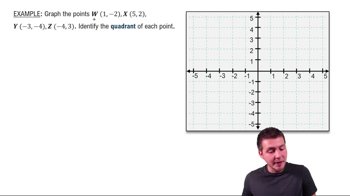
 02:16
02:16