Skip to main content
Precalculus
나의 코스
배우기
시험 준비
AI 튜터
학습 가이드
플래시카드
탐험해 보세요
앱을 사용해 보세요
나의 코스
배우기
시험 준비
AI 튜터
학습 가이드
플래시카드
탐험해 보세요
앱을 사용해 보세요
뒤로
Introduction to Limits quiz
카드를 뒤집기 위해 탭할 수 있습니다.
What does the notation lim_{x→c} f(x) represent?
카드를 뒤집기 위해 탭할 수 있습니다.
👆
What does the notation lim_{x→c} f(x) represent?
It represents the limit of the function f(x) as x approaches the value c, or the y-value f(x) approaches as x gets close to c.
진행 상황 추적
컨트롤 버튼이 '내비게이션' 모드로 변경되었습니다.
1/15
관련 플래시카드
관련 실천
추천 영상
Introduction to Limits definitions
Introduction to Limits
15 용어
Introduction to Limits
22. Limits & Continuity
5 문제점
주제
Finding Limits Algebraically
22. Limits & Continuity
5 문제점
주제
22. Limits & Continuity
3 주제
9 문제점
장
VideoThumbView.guidedCourse
02:34
Finding Limits Numerically and Graphically Example 1
454
views
5
rank
VideoThumbView.guidedCourse
03:07
Cases Where Limits Do Not Exist
381
views
3
rank
VideoThumbView.guidedCourse
06:47
Finding Limits Numerically and Graphically
703
views
8
rank
이 집합의 용어 (15)
하이드의 정의
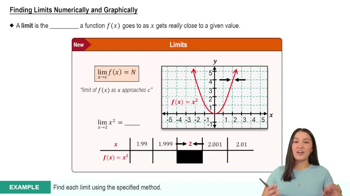
What does the notation lim_{x→c} f(x) represent?
It represents the limit of the function f(x) as x approaches the value c, or the y-value f(x) approaches as x gets close to c.
How can you estimate a limit using a graph?
You look at the y-value the function approaches as x gets close to the target value from both sides on the graph.
What is a one-sided limit?
A one-sided limit examines the behavior of a function as x approaches a value from only one side, either the left or the right.
How is the left-sided limit of f(x) as x approaches c written in notation?
It is written as lim_{x→c^-} f(x), indicating x approaches c from the left.
How is the right-sided limit of f(x) as x approaches c written in notation?
It is written as lim_{x→c^+} f(x), indicating x approaches c from the right.
When does the limit of f(x) as x approaches c exist?
The limit exists if the function approaches the same y-value from both the left and right as x approaches c.
What does it mean if the left and right limits as x approaches c are not equal?
It means the overall limit as x approaches c does not exist (DNE).
Why can't you always find a limit by plugging in the value of c into the function?
Because the function value at c may not match the value the function approaches as x gets close to c, or the function may not even be defined at c.
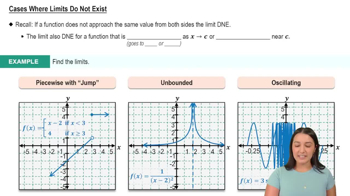
What is a common scenario where a limit does not exist due to a 'jump'?
A limit does not exist at a point where a piecewise function has a jump, meaning the left and right limits are different.
What happens to the limit if the function approaches infinity as x approaches c?
The limit does not exist because infinity is not a number; this is called unbounded behavior.
What type of function behavior near c causes the limit to not exist due to oscillation?
If the function oscillates (goes up and down repeatedly) as x approaches c, the limit does not exist.
How can you use a table of values to estimate a limit?
By plugging in values of x that get closer and closer to c from both sides and observing the y-values they approach.
If lim_{x→1^-} f(x) = -1 and lim_{x→1^+} f(x) = -1, what is lim_{x→1} f(x)?
lim_{x→1} f(x) = -1, because the left and right limits are equal.
If lim_{x→3^-} f(x) = 1 and lim_{x→3^+} f(x) = 4, what can you say about lim_{x→3} f(x)?
The limit does not exist because the left and right limits are not equal.
What are three common cases where a limit does not exist?
Limits do not exist when there is a jump (piecewise function), unbounded behavior (approaching infinity), or oscillation near the point.
 뒤로뒤로
뒤로뒤로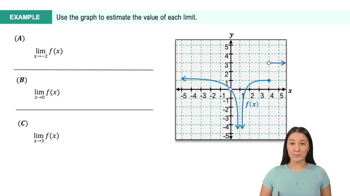
 02:34
02:34