Skip to main content
Precalculus
나의 코스
배우기
시험 준비
AI 튜터
학습 가이드
플래시카드
탐험해 보세요
앱을 사용해 보세요
나의 코스
배우기
시험 준비
AI 튜터
학습 가이드
플래시카드
탐험해 보세요
앱을 사용해 보세요
뒤로
Limits at Infinity quiz
카드를 뒤집기 위해 탭할 수 있습니다.
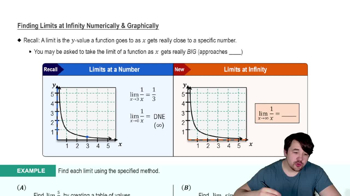
What does the limit of 1/x approach as x approaches infinity?
카드를 뒤집기 위해 탭할 수 있습니다.
👆
What does the limit of 1/x approach as x approaches infinity?
The limit approaches 0 as x approaches infinity.
진행 상황 추적
컨트롤 버튼이 '내비게이션' 모드로 변경되었습니다.
1/15
관련 플래시카드
관련 실천
추천 영상
Limits at Infinity definitions
Limits at Infinity
15 용어
Limits at Infinity
23. Intro to Derivatives & Area Under the Curve
5 문제점
주제
Limits of Sequences
23. Intro to Derivatives & Area Under the Curve
5 문제점
주제
23. Intro to Derivatives & Area Under the Curve
4 주제
12 문제점
장
06:25
Finding Limits at Infinity Algebraically
348
views
4
rank
04:55
Finding Limits at Infinity Numerically and Graphically
445
views
5
rank
02:43
Finding Limits at Infinity Algebraically Example 1
319
views
6
rank
이 집합의 용어 (15)
하이드의 정의
What does the limit of 1/x approach as x approaches infinity?
The limit approaches 0 as x approaches infinity.
When evaluating the limit as x approaches infinity for 5/x, what value does the function approach?
The function approaches 0 as x approaches infinity.
What happens to the function sin(x) as x approaches negative infinity?
The function oscillates between 1 and -1, so the limit does not exist.
What is the general strategy for solving limits at infinity for rational functions algebraically?
Divide each term in the numerator and denominator by the highest power of x present in the function.
What shortcut can you use to quickly determine the limit at infinity for a rational function?
Compare the highest powers of x in the numerator and denominator to decide the limit's behavior.
If the highest power of x is greater in the denominator than in the numerator, what does the limit approach as x approaches infinity?
The limit approaches 0.
If the highest power of x is greater in the numerator than in the denominator, what happens to the limit as x approaches infinity?
The limit does not exist because the function approaches positive or negative infinity.
When the highest powers of x in the numerator and denominator are equal, how do you find the limit at infinity?
The limit is the ratio of the leading coefficients of the highest power terms.
Does the shortcut for limits at infinity work for both positive and negative infinity?
Yes, the shortcut works for both positive and negative infinity.
Why does a rational function with a higher degree in the denominator approach 0 as x approaches infinity?
Because the denominator grows much faster than the numerator, making the whole fraction approach 0.
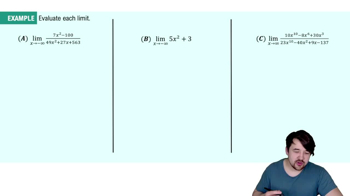
What is the limit as x approaches infinity for the function (3x^2 + 4x - 1)/(x^3 + 27)?
The limit is 0.
What is the limit as x approaches infinity for the function (2x^4 - x)/(x^2 + 5)?
The limit does not exist because the numerator's degree is higher than the denominator's.
What is the limit as x approaches negative infinity for the function (2x + 1)/(5x - 1)?
The limit is 2/5, the ratio of the leading coefficients.
What does it mean if a function's limit at infinity does not exist?
It means the function grows without bound, approaching positive or negative infinity, or oscillates without settling to a value.
How do you determine the leading coefficient in a rational function for limits at infinity?
The leading coefficient is the coefficient of the term with the highest power of x in the numerator or denominator.
 뒤로뒤로
뒤로뒤로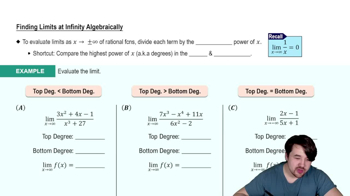
 06:25
06:25