Skip to main content
Precalculus
나의 코스
배우기
시험 준비
AI 튜터
학습 가이드
플래시카드
탐험해 보세요
앱을 사용해 보세요
나의 코스
배우기
시험 준비
AI 튜터
학습 가이드
플래시카드
탐험해 보세요
앱을 사용해 보세요
뒤로
Linear Trigonometric Equations definitions
1 학생이 이 점이 도움이 되었다고 느꼈습니다
카드를 뒤집기 위해 탭할 수 있습니다.
Unit Circle
카드를 뒤집기 위해 탭할 수 있습니다.
👆
Unit Circle
A circle of radius one centered at the origin, used to determine angle values for trigonometric functions.
진행 상황 추적
컨트롤 버튼이 '내비게이션' 모드로 변경되었습니다.
1/15
관련 플래시카드
관련 실천
추천 영상
Linear Trigonometric Equations quiz
Linear Trigonometric Equations
15 용어
Linear Trigonometric Equations
11. Inverse Trigonometric Functions and Basic Trig Equations
5 문제점
주제
Evaluate Composite Trig Functions
11. Inverse Trigonometric Functions and Basic Trig Equations
4 문제점
주제
11. Inverse Trigonometric Functions and Basic Trig Equations
3 주제
7 문제점
장
VideoThumbView.guidedCourse
3:29
Example 3
778
views
33
rank
1
comments
VideoThumbView.guidedCourse
2:17
Example 2
765
views
17
rank
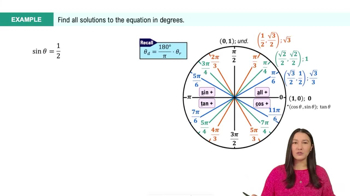
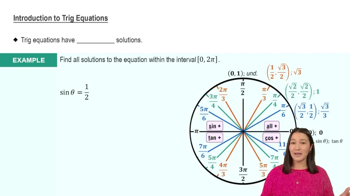
VideoThumbView.guidedCourse
4:25
Introduction to Trig Equations
1251
views
31
rank
이 집합의 용어 (15)
하이드의 정의
Unit Circle
A circle of radius one centered at the origin, used to determine angle values for trigonometric functions.
Interval
A specified range of angle values, often given in radians, within which solutions are sought.
Quadrant
One of four sections of the coordinate plane, each affecting the sign of trigonometric function values.
Rotation
A complete turn around the unit circle, corresponding to an angle of 2π radians.
General Solution
An expression representing all possible solutions to a trigonometric equation, often involving 2πn.
Linear Trigonometric Equation
An equation where a trigonometric function appears linearly, similar in form to a linear algebraic equation.
Algebraic Operations
Basic manipulations such as addition, subtraction, multiplication, and division used to isolate variables or functions.
Trig Function
A mathematical function such as sine or cosine, relating an angle to a ratio of sides in a right triangle or coordinates on the unit circle.
Domain
The set of allowable input values, often specified as an interval for angle measures in trigonometric equations.
Solution Set
The complete collection of angle values that satisfy a given trigonometric equation.
Integer Parameter
A variable, often denoted as n or k, representing the number of full rotations added to a solution.
Isolating the Trig Function
The process of rearranging an equation so that the trigonometric function stands alone on one side.
Restricted Domain
A limitation on the set of possible angle values, such as confining solutions to a single rotation.
Basic Trig Equation
A trigonometric equation in its simplest form, such as sine or cosine of an angle equaling a constant.
Multiple Solutions
The occurrence of more than one angle value satisfying a trigonometric equation, often due to periodicity.
 뒤로뒤로
뒤로뒤로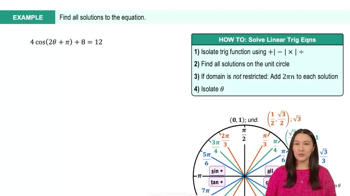
 3:29
3:29