Skip to main content
Precalculus
나의 코스
배우기
시험 준비
AI 튜터
학습 가이드
플래시카드
탐험해 보세요
앱을 사용해 보세요
나의 코스
배우기
시험 준비
AI 튜터
학습 가이드
플래시카드
탐험해 보세요
앱을 사용해 보세요
뒤로
Products and Quotients of Complex Numbers definitions
카드를 뒤집기 위해 탭할 수 있습니다.
Complex Number
카드를 뒤집기 위해 탭할 수 있습니다.
👆
Complex Number
A value expressed as a combination of a real part and an imaginary part, often written in rectangular or polar form.
진행 상황 추적
컨트롤 버튼이 '내비게이션' 모드로 변경되었습니다.
1/15
관련 플래시카드
관련 실천
추천 영상
Products and Quotients of Complex Numbers quiz
Products and Quotients of Complex Numbers
15 용어
Products and Quotients of Complex Numbers
17. Graphing Complex Numbers
3 문제점
주제
Powers of Complex Numbers (DeMoivre's Theorem)
17. Graphing Complex Numbers
5 문제점
주제
17. Graphing Complex Numbers
4 주제
7 문제점
장
03:40
Quotients of Complex Numbers in Polar Form
358
views
8
rank
04:46
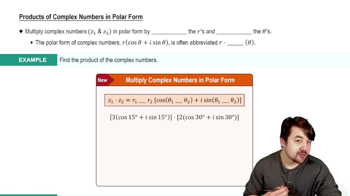
Products of Complex Numbers in Polar Form
456
views
11
rank
이 집합의 용어 (15)
하이드의 정의
Complex Number
A value expressed as a combination of a real part and an imaginary part, often written in rectangular or polar form.
Polar Form
A representation using a modulus and an angle, typically written as r cis θ or r(cos θ + i sin θ).
Rectangular Form
A way to express a value as a sum of real and imaginary components, usually as a + bi.
Modulus
The distance from the origin to the point representing a value in the complex plane, denoted as r in polar form.
Argument
The angle measured from the positive real axis to the line representing a value in the complex plane, denoted as θ.
cis Notation
A shorthand for cos θ + i sin θ, allowing compact expression of values in polar form.
Product
The result of multiplying two values, found by multiplying moduli and adding arguments in polar form.
Quotient
The result of dividing two values, found by dividing moduli and subtracting arguments in polar form.
Multiplication Rule
A process involving multiplying moduli and adding arguments to combine two values in polar form.
Division Rule
A process involving dividing moduli and subtracting arguments to separate two values in polar form.
Angle Addition
A step in multiplication where the arguments of two values are summed to find the new argument.
Angle Subtraction
A step in division where the argument of the divisor is subtracted from the argument of the dividend.
Radian
A unit for measuring angles, often used in polar form, where π radians equals 180 degrees.
Degree
A unit for measuring angles, commonly used alongside radians in polar representations.
Complex Plane
A two-dimensional plane where the horizontal axis represents real parts and the vertical axis represents imaginary parts.
 뒤로뒤로
뒤로뒤로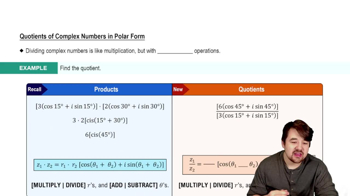
 03:40
03:40