Skip to main content
Precalculus
나의 코스
배우기
시험 준비
AI 튜터
학습 가이드
플래시카드
탐험해 보세요
앱을 사용해 보세요
나의 코스
배우기
시험 준비
AI 튜터
학습 가이드
플래시카드
탐험해 보세요
앱을 사용해 보세요
뒤로
Understanding Polynomial Functions quiz
카드를 뒤집기 위해 탭할 수 있습니다.
What are the only types of exponents allowed in a polynomial function?
카드를 뒤집기 위해 탭할 수 있습니다.
👆
What are the only types of exponents allowed in a polynomial function?
Only positive whole number exponents are allowed in a polynomial function; no negatives or fractions.
진행 상황 추적
컨트롤 버튼이 '내비게이션' 모드로 변경되었습니다.
1/15
관련 플래시카드
관련 실천
추천 영상
Understanding Polynomial Functions definitions
Understanding Polynomial Functions
14 용어
Understanding Polynomial Functions
4. Polynomial Functions
5 문제점
주제
Graphing Polynomial Functions
4. Polynomial Functions
2 문제점
주제
4. Polynomial Functions
3 주제
7 문제점
장
VideoThumbView.guidedCourse
06:04
Introduction to Polynomial Functions
3802
views
145
rank
VideoThumbView.guidedCourse
03:42
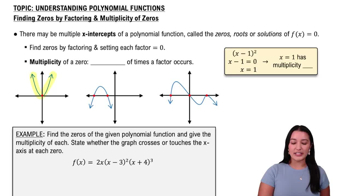
Finding Zeros & Their Multiplicity
1928
views
75
rank
VideoThumbView.guidedCourse
06:08
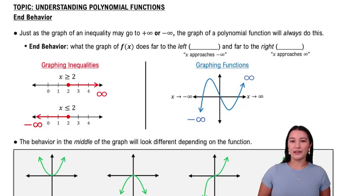
End Behavior of Polynomial Functions
2085
views
87
rank
이 집합의 용어 (15)
하이드의 정의
What are the only types of exponents allowed in a polynomial function?
Only positive whole number exponents are allowed in a polynomial function; no negatives or fractions.
How is a polynomial written in standard form?
A polynomial is written in standard form by combining like terms and arranging terms in descending order of power.
What is the leading coefficient of a polynomial function?
The leading coefficient is the coefficient of the term with the highest power in the polynomial.
How do you determine the degree of a polynomial function?
The degree is the highest exponent of the variable in the polynomial when written in standard form.
Can a polynomial function have a fraction as a coefficient?
Yes, a polynomial function can have a fraction as a coefficient, but not as an exponent.
What are two key features of the graph of any polynomial function?
The graph of any polynomial function is smooth and continuous, with no corners or breaks.
What is the domain of any polynomial function?
The domain of any polynomial function is all real numbers, or from negative infinity to positive infinity.
What determines the end behavior of a polynomial function's graph?
The end behavior is determined by the leading coefficient and the degree of the polynomial.
How does the sign of the leading coefficient affect the right end of the graph?
If the leading coefficient is positive, the right end rises; if negative, the right end falls.
What does it mean if the degree of a polynomial is even regarding end behavior?
If the degree is even, both ends of the graph have the same behavior (both rise or both fall).
How do you find the x-intercepts (zeros) of a polynomial function?
Set the polynomial equal to zero and solve, usually by factoring, to find the x-intercepts.
What is the multiplicity of a zero, and how does it affect the graph?
Multiplicity is the number of times a factor occurs; even multiplicity means the graph touches and bounces off the axis, odd means it crosses.
How do you determine the maximum number of turning points in a polynomial graph?
The maximum number of turning points is one less than the degree of the polynomial (n - 1).
What are turning points in the context of polynomial graphs?
Turning points are where the graph changes direction from increasing to decreasing or vice versa, and can be local maxima or minima.
If a polynomial has degree 4, what is the maximum number of turning points it can have?
A degree 4 polynomial can have at most 3 turning points.
 뒤로뒤로
뒤로뒤로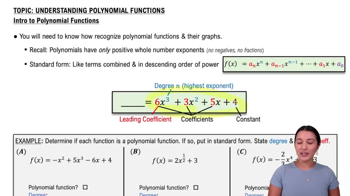
 06:04
06:04