Skip to main content
Precalculus
나의 코스
배우기
시험 준비
AI 튜터
학습 가이드
플래시카드
탐험해 보세요
앱을 사용해 보세요
나의 코스
배우기
시험 준비
AI 튜터
학습 가이드
플래시카드
탐험해 보세요
앱을 사용해 보세요
뒤로
Vectors in Component Form quiz
카드를 뒤집기 위해 탭할 수 있습니다.
What is a position vector?
카드를 뒤집기 위해 탭할 수 있습니다.
👆
What is a position vector?
A position vector is a vector whose initial point is at the origin of the graph.
진행 상황 추적
컨트롤 버튼이 '내비게이션' 모드로 변경되었습니다.
1/15
관련 플래시카드
관련 실천
추천 영상
Vectors in Component Form definitions
Vectors in Component Form
15 용어
Vectors in Component Form
14. Vectors
3 문제점
주제
Direction of a Vector
14. Vectors
3 문제점
주제
14. Vectors
6 주제
11 문제점
장
02:26
Finding Magnitude of a Vector Example 1
469
views
12
rank
03:11
Algebraic Operations on Vectors Example 1
451
views
14
rank
01:36
Position Vectors & Component Form Example 1
497
views
9
rank
이 집합의 용어 (15)
하이드의 정의
What is a position vector?
A position vector is a vector whose initial point is at the origin of the graph.
How do you write a vector in component form?
A vector in component form is written as (x, y), where x and y are the lengths in the x and y directions.
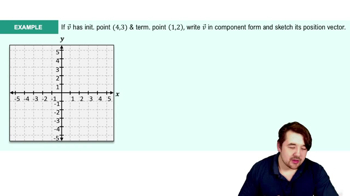
How do you find the component form of a vector given its initial and terminal points?
Subtract the initial point from the terminal point for both x and y: (x2 - x1, y2 - y1).
What does the x component of a vector represent?
The x component represents how far the vector moves in the x direction.
What does the y component of a vector represent?
The y component represents how far the vector moves in the y direction.
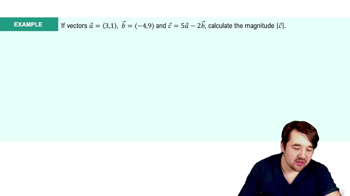
How do you calculate the magnitude of a vector in component form?
Use the formula: magnitude = sqrt(x^2 + y^2), where x and y are the vector's components.
Which theorem is used to find the magnitude of a vector?
The Pythagorean theorem is used to find the magnitude of a vector.
If a vector has components (4, 3), what is its magnitude?
Its magnitude is 5, since sqrt(4^2 + 3^2) = sqrt(16 + 9) = sqrt(25) = 5.
How do you add two vectors in component form?
Add their corresponding x components and y components: (x1 + x2, y1 + y2).
How do you subtract one vector from another in component form?
Subtract their corresponding components: (x1 - x2, y1 - y2).
What is the result of adding vectors (2, 3) and (3, -1)?
The result is (5, 2), since 2+3=5 and 3+(-1)=2.
How do you multiply a vector by a scalar?
Multiply each component of the vector by the scalar: k(x, y) = (kx, ky).
What is 3 times the vector (2, 4)?
It is (6, 12), since 3*2=6 and 3*4=12.
If v = (8, 5) and u = (2, 4), what is v - 3u?
First, 3u = (6, 12); then v - 3u = (8-6, 5-12) = (2, -7).
Why is mastering vector operations in component form important?
It is essential for further studies in mathematics and physics, as these operations are foundational for more advanced topics.
 뒤로뒤로
뒤로뒤로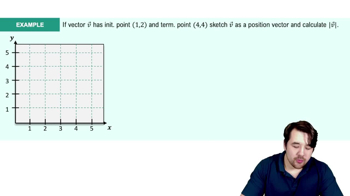
 02:26
02:26