Skip to main content
Precalculus
나의 코스
배우기
시험 준비
AI 튜터
학습 가이드
플래시카드
탐험해 보세요
앱을 사용해 보세요
나의 코스
배우기
시험 준비
AI 튜터
학습 가이드
플래시카드
탐험해 보세요
앱을 사용해 보세요
뒤로
Writing Parametric Equations quiz
카드를 뒤집기 위해 탭할 수 있습니다.
What is the first step in writing parametric equations from a rectangular equation?
카드를 뒤집기 위해 탭할 수 있습니다.
👆
What is the first step in writing parametric equations from a rectangular equation?
The first step is to choose an expression for the parameter t, often involving x or y.
진행 상황 추적
컨트롤 버튼이 '내비게이션' 모드로 변경되었습니다.
1/15
관련 플래시카드
관련 실천
추천 영상
Writing Parametric Equations definitions
Writing Parametric Equations
15 용어
Writing Parametric Equations
16. Parametric Equations
3 문제점
주제
Eliminate the Parameter
16. Parametric Equations
3 문제점
주제
16. Parametric Equations
3 주제
2 문제점
장
08:02
Parameterizing Equations
365
views
8
rank
06:03
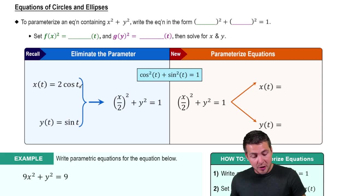
Equations of Circles & Ellipses
314
views
6
rank
04:26
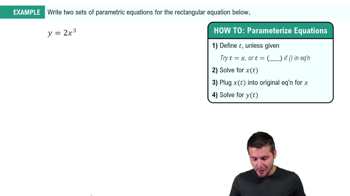
Parameterizing Equations Example 1
284
views
5
rank
이 집합의 용어 (15)
하이드의 정의
What is the first step in writing parametric equations from a rectangular equation?
The first step is to choose an expression for the parameter t, often involving x or y.
Why is it common to set t equal to x when parameterizing an equation?
Setting t equal to x is simple and avoids domain restrictions, making it a reliable choice for most problems.
After defining t, what is the next step in finding parametric equations?
Solve for x in terms of t to get x(t), then substitute this into the original equation to find y(t).
Why should you avoid choosing t as an even power of x, like x^2, when parameterizing?
Choosing t as an even power of x can restrict the domain and may lead to imaginary numbers if t is negative.
How do you parameterize equations involving x^2 + y^2?
Use the Pythagorean identity by setting x and y in terms of cosine and sine functions of t.
What should you do if the equation is not in the form f(x)^2 + g(y)^2 = 1?
Rewrite the equation, often by dividing both sides by a constant, to get it into the form f(x)^2 + g(y)^2 = 1.
How do you find x(t) for an equation like x^2/4 + y^2 = 1?
Set x/2 = cos(t), so x(t) = 2cos(t).
How do you find y(t) for an equation like x^2/4 + y^2 = 1?
Set y = sin(t), so y(t) = sin(t).
What is a good way to check if your parametric equations are correct?
Eliminate the parameter t from your parametric equations to see if you return to the original rectangular equation.
If t = x + 1, how do you express x in terms of t?
Solve for x to get x(t) = t - 1.
Given y = 2x + 5 and t = x + 1, what is y(t)?
Substitute x(t) into y to get y(t) = 2(t - 1) + 5 = 2t + 3.
For y = (x + 2)^2 - 3, what is a good choice for t?
Set t equal to the expression inside the parentheses, so t = x + 2.
Given t = x + 2, how do you write x(t) and y(t) for y = (x + 2)^2 - 3?
x(t) = t - 2 and y(t) = t^2 - 3.
How do you parameterize 9x^2 + y^2 = 9?
Rewrite as x^2 + (y^2)/9 = 1, then set x = cos(t) and y = 3sin(t).
Why is it important to avoid domain restrictions when choosing t?
Domain restrictions can limit the possible values of t and may result in undefined or imaginary values for x or y.
 뒤로뒤로
뒤로뒤로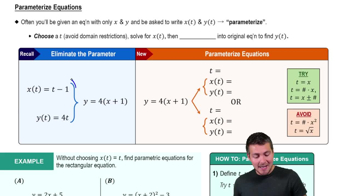
 08:02
08:02