Skip to main content
Precalculus
나의 코스
배우기
시험 준비
AI 튜터
학습 가이드
플래시카드
탐험해 보세요
앱을 사용해 보세요
나의 코스
배우기
시험 준비
AI 튜터
학습 가이드
플래시카드
탐험해 보세요
앱을 사용해 보세요
뒤로
Exponential Functions - Precalculus
카드를 뒤집기 위해 탭할 수 있습니다.
What is the general form of an exponential function?
카드를 뒤집기 위해 탭할 수 있습니다.
👆
What is the general form of an exponential function?
An exponential function is of the form \(f(x) = a^x\), where
a
is a positive real number and
x
is any real number.
진행 상황 추적
컨트롤 버튼이 '내비게이션' 모드로 변경되었습니다.
1/20
추천 영상
VideoThumbView.guidedCourse
6:13
Exponential Functions
3335
views
124
rank
3
comments
이 집합의 용어 (20)
하이드의 정의
What is the general form of an exponential function?
An exponential function is of the form \(f(x) = a^x\), where
a
is a positive real number and
x
is any real number.
What is the domain and range of the exponential function \(f(x) = a^x\) with a > 0?
The domain is all real numbers, and the range is all positive real numbers.
What is the horizontal asymptote of the exponential function \(f(x) = a^x\)?
The horizontal asymptote is the line
y = 0
.
How does the graph of \(f(x) = a^x\) behave when a > 1?
The function is increasing, one-to-one, with y-intercept at (0,1), and the graph rises rapidly as x increases.
How does the graph of \(f(x) = a^x\) behave when 0 < a < 1?
The function is decreasing, one-to-one, with y-intercept at (0,1), and the graph approaches zero as x increases.
What is the number e and how is it defined?
The number e is the limit of \((1 + \frac{1}{n})^n\) as n approaches infinity, approximately 2.718.
What is the domain and range of the function \(f(x) = e^x\)?
The domain is all real numbers, and the range is all positive real numbers.
What is the y-intercept of any exponential function \(f(x) = a^x\)?
The y-intercept is always at (0, 1) because \(a^0 = 1\).
How do you solve exponential equations with the same base?
If \(a^u = a^v\), then
u = v
.
What is the growth factor in an exponential function?
The growth factor is the base
a
in \(f(x) = a^x\) and determines whether the function grows (a > 1) or decays (0 < a < 1).
How can you identify if a function is linear or exponential from data?
If the average rate of change is constant, the function is linear. If the ratio of consecutive outputs is constant, the function is exponential.
What is the horizontal asymptote of the function \(f(x) = a^{x} + k\)?
The horizontal asymptote is the line
y = k
.
What is the effect of reflecting an exponential function about the y-axis?
Replacing x by -x reflects the graph about the y-axis, changing growth to decay or vice versa.
What is the effect of vertical shifts on the graph of an exponential function?
Adding a constant k shifts the graph up or down by k units, changing the horizontal asymptote to y = k.
What is the domain and range of the function \(f(x) = -e^x\)?
The domain is all real numbers; the range is all negative real numbers.
How do you graph an exponential function using a table of values?
Calculate values for selected x, plot points, note the y-intercept at (0,1), and identify the horizontal asymptote y=0.
What is the significance of the horizontal asymptote in exponential functions?
It represents the value the function approaches but never reaches as x approaches infinity or negative infinity.
How is exponential probability modeled using exponential functions?
Probability that an event occurs within time t is modeled by \(F(t) = 1 - e^{-kt}\), where k is the rate parameter.
What happens to the probability \(F(t)\) as time t increases without bound?
The probability approaches 1, meaning the event is almost certain to occur eventually.
How do you use a calculator to evaluate exponential expressions like \(1 - e^{-0.25 \times 5}\)?
Use the calculator's exponential function and arithmetic operations to compute the value directly.
 뒤로뒤로
뒤로뒤로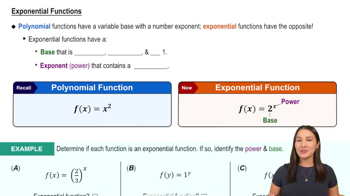
 6:13
6:13