A polynomial function in one variable is a function of the form \(a_nx^n + a_{n-1}x^{n-1} + \cdots + a_1x + a_0\), where coefficients are constants, n is a nonnegative integer, and x is the variable.
What is the domain of a polynomial function?
The domain of a polynomial function is the set of all real numbers.
What is the degree of a polynomial function?
The degree is the highest power of the variable with a nonzero coefficient in the polynomial.
What is the leading coefficient and leading term?
The leading coefficient is the coefficient of the term with the highest degree. The leading term is the term with the highest degree.
What is a power function?
A power function of degree n is a monomial function of the form \(f(x) = ax^n\), where a is a real number and n > 0 is an integer.
Properties of power functions when n is a positive even integer?
The function is even, symmetric about the y-axis, domain is all real numbers, range is nonnegative real numbers, and the graph passes through (−1,1), (0,0), and (1,1).
Properties of power functions when n is a positive odd integer?
The function is odd, symmetric about the origin, domain and range are all real numbers, and the graph passes through (−1,−1), (0,0), and (1,1).
What does the graph of every polynomial function look like?
The graph is smooth and continuous, meaning no sharp corners, cusps, gaps, or holes.
How do you find the real zeros of a polynomial function?
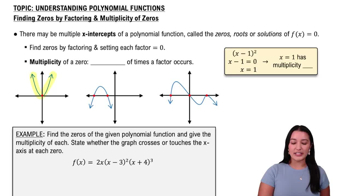
Factor the polynomial completely and solve the equation using the Zero-Product Property.
What is a real zero of a polynomial function?
A real zero r satisfies \(f(r) = 0\). It is an x-intercept and \(x - r\) is a factor of the polynomial.
What is the multiplicity of a real zero?
If \((x - r)^m\) is a factor of the polynomial but \((x - r)^{m+1}\) is not, then r is a real zero of multiplicity m.
How does multiplicity affect the graph at a zero?
If multiplicity is odd, the graph crosses the x-axis at the zero. If even, the graph touches and turns around at the zero.
What is the maximum number of turning points of a polynomial function of degree n?
The graph has at most n − 1 turning points.
What is the end behavior of a polynomial function?
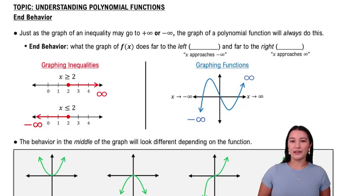
The end behavior matches that of the leading term's power function \(a_nx^n\).
How can you graph a polynomial function using transformations?
Rewrite the function to identify shifts, reflections, stretches, and compressions, then apply these transformations step-by-step to the base graph.
How do you determine intervals where a polynomial graph is above or below the x-axis?
Use the x-intercepts to divide the x-axis into intervals, then test points in each interval to see if the function values are positive or negative.
What does it mean if a polynomial graph is not smooth or continuous?
It cannot be the graph of a polynomial function because polynomial graphs have no gaps, holes, or corners.
How do you find a polynomial function from its zeros?
Write the polynomial as a product of factors \((x - r_i)\) for each zero r_i, then multiply and adjust the leading coefficient if needed.
What is the effect of the leading coefficient on the graph?
The leading coefficient causes vertical stretch, compression, or reflection but does not affect the x-intercepts.
How do you verify a polynomial function from a graph?
Check the zeros, multiplicities, degree, and leading coefficient by comparing the function values and shape to the graph.
 뒤로
뒤로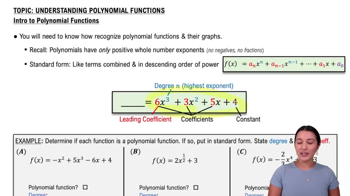
 06:04
06:04