 뒤로
뒤로Precalculus: Analytic Trigonometry - Double-Angle and Half-Angle Formulas
 5:06
5:06
이 집합의 용어 (20)
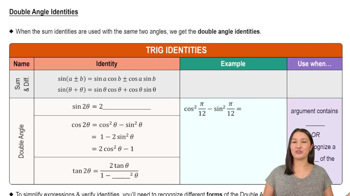
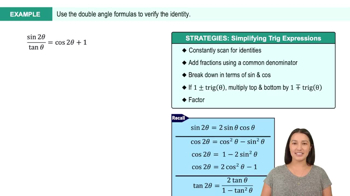
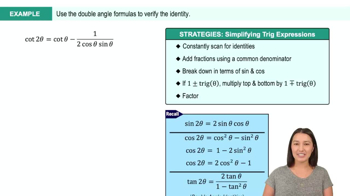
cos(2θ) = cos²θ − sin²θ
sin(2θ) = 2 sinθ cosθ
cos(2θ) = 2 cos²θ − 1
cos(2θ) = 1 − 2 sin²θ
sin(θ/2) = ±√((1 − cosθ)/2), sign depends on quadrant of θ/2
cos(θ/2) = ±√((1 + cosθ)/2), sign depends on quadrant of θ/2
Use sin(2θ) = 2 sinθ cosθ and substitute the known values.
R = (v² sin(2θ)) / g, where g is acceleration due to gravity.
The range is maximized at θ = 45°.
Rewrite the equation using double-angle identities, then solve for the angle considering the general solution.
tan(θ/2) = ±√((1 − cosθ)/(1 + cosθ)), or tan(θ/2) = sinθ / (1 + cosθ), sign depends on quadrant.
The sign (+ or −) depends on the quadrant in which the half-angle lies.
sin²θ = (1 − cos(2θ)) / 2
cos²θ = (1 + cos(2θ)) / 2
Use power-reducing formulas derived from double-angle identities.
θ = (1/2) arcsin(k) + nπ, where n is any integer.
Apply the half-angle formulas with known cosine or sine values and determine the correct sign based on the quadrant.
For a circle of radius r, x = r cosθ and y = r sinθ.
Use x = r cosθ, where r is the radius.
r = √(x² + y²)