Skip to main content
Precalculus
나의 코스
배우기
시험 준비
AI 튜터
학습 가이드
플래시카드
탐험해 보세요
앱을 사용해 보세요
나의 코스
배우기
시험 준비
AI 튜터
학습 가이드
플래시카드
탐험해 보세요
앱을 사용해 보세요
뒤로
Precalculus Midterm 2 Practice Flashcards
카드를 뒤집기 위해 탭할 수 있습니다.
Write the quadratic function q(x) = x² − 10x + 3 in standard form.
카드를 뒤집기 위해 탭할 수 있습니다.
👆
Write the quadratic function q(x) = x² − 10x + 3 in standard form.
Standard form is \(a(x-h)^2+k\). Complete the square to get \((x-5)^2-22\).
진행 상황 추적
컨트롤 버튼이 '내비게이션' 모드로 변경되었습니다.
1/14
추천 영상
VideoThumbView.guidedCourse
07:42
Properties of Parabolas
3816
views
117
rank
1
comments
VideoThumbView.guidedCourse
08:07
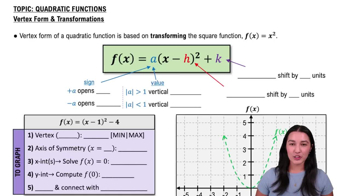
Vertex Form
2156
views
84
rank
VideoThumbView.guidedCourse
07:11
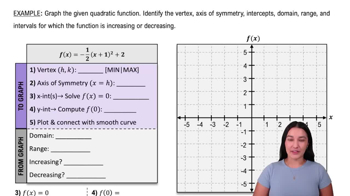
Example 1
1759
views
54
rank
3
comments
이 집합의 용어 (14)
하이드의 정의
Write the quadratic function q(x) = x² − 10x + 3 in standard form.
Standard form is \(a(x-h)^2+k\). Complete the square to get \((x-5)^2-22\).
Solve the inequality 3x + 5 / (x + 9) ≥ 0 in interval form.
Find zeros and undefined points: numerator zero at
x = -5/3
, denominator zero at
x = -9
. Test intervals to get solution
(-9, -5/3]
.
Solve the inequality x² + 3x − 4 ≤ 0 in interval form.
Factor as \((x+4)(x-1)\). Inequality holds between roots, so solution is
[-4, 1]
.
Find the vertex of q(x) = x² − 6x − 7.
Vertex form: complete the square or use \(h=-\frac{b}{2a}\). Vertex is
(3, -16)
.
Find the x-intercepts of q(x) = x² − 6x − 7.
Solve \(x^2-6x-7=0\). Roots are
x = 7
and
x = -1
. Intercepts are points (7,0) and (-1,0).
Calculate the horizontal asymptote(s) of R(x) = (x + 213)(x + 51) / (x + 20)(x − 12).
Degrees of numerator and denominator are equal. Horizontal asymptote is ratio of leading coefficients:
y = 1
.
Calculate the vertical asymptote(s) of R(x) = (x + 213)(x + 51) / (x + 20)(x − 12).
Vertical asymptotes occur where denominator is zero:
x = -20
and
x = 12
.
Explain what R(−10,000) is approximately equal to without calculating.
For large |x|, R(x) ≈ ratio of leading terms, so R(−10,000) ≈
1
.
Why is the horizontal asymptote of h(x) = (666x − 5.6) / (x² + 1) equal to y = 0?
Degree of denominator (2) is greater than numerator (1), so horizontal asymptote is
y = 0
.
Find the standard form of a parabola with vertex (1,1) passing through (2,2).
Use vertex form \(y=a(x-1)^2+1\). Substitute (2,2) to find
a=1
. Equation: \(y=(x-1)^2+1\).
Calculate the base b that gives maximum area for A(b) = 26b − b².
Maximum at vertex: \(b=\frac{-26}{-2} = 13\).
Calculate the maximum area for A(b) = 26b − b² when b = 13.
Substitute b=13: \(A(13)=26(13)-13^2=169\).
Explain why the calculated area at b=13 is a maximum.
The quadratic has a negative leading coefficient (
-1
), so the parabola opens downward, making the vertex a maximum.
Describe a quadratic polynomial with no x-intercepts.
A parabola that does not cross the x-axis has a
negative discriminant
and lies entirely above or below the x-axis.
 뒤로뒤로
뒤로뒤로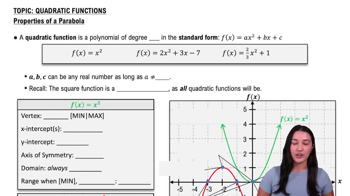
 07:42
07:42