Skip to main content
Precalculus
나의 코스
배우기
시험 준비
AI 튜터
학습 가이드
플래시카드
탐험해 보세요
앱을 사용해 보세요
나의 코스
배우기
시험 준비
AI 튜터
학습 가이드
플래시카드
탐험해 보세요
앱을 사용해 보세요
뒤로
Precalculus: Polynomial Functions
카드를 뒤집기 위해 탭할 수 있습니다.
What defines a polynomial function?
카드를 뒤집기 위해 탭할 수 있습니다.
👆
What defines a polynomial function?
A polynomial function is defined as \(f(x) = a_nx^n + a_{n-1}x^{n-1} + \cdots + a_1x + a_0\) where n is a nonnegative integer and
a_n \(\neq\) 0
.
진행 상황 추적
컨트롤 버튼이 '내비게이션' 모드로 변경되었습니다.
1/20
추천 영상
03:34
Adding and Subtracting Polynomials
1597
views
56
rank
05:16
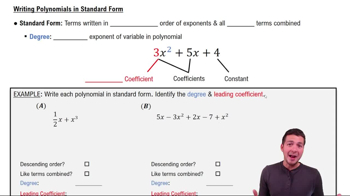
Standard Form of Polynomials
1787
views
73
rank
05:13
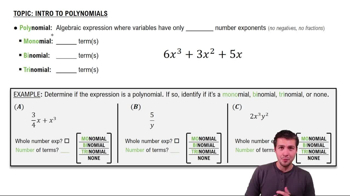
Introduction to Polynomials
2522
views
102
rank
2
comments
이 집합의 용어 (20)
하이드의 정의
What defines a polynomial function?
A polynomial function is defined as \(f(x) = a_nx^n + a_{n-1}x^{n-1} + \cdots + a_1x + a_0\) where n is a nonnegative integer and
a_n \(\neq\) 0
.
What is the degree of a polynomial?
The degree of a polynomial is the highest power of the variable with a nonzero coefficient.
Is \(f(x) = x + 3\) a polynomial? If yes, what is its degree?
Yes, it is a polynomial of degree 1.
Is \(g(x) = 7x^5 - \pi x^3 + \frac{1}{5}x\) a polynomial? If yes, what is its degree?
Yes, it is a polynomial of degree 5.
Is \(h(x) = 8x^3 - x^2 + \frac{2}{x}\) a polynomial? Why or why not?
No, because it contains a term with
x
in the denominator, which is not allowed in polynomials.
What is the end behavior of a polynomial with odd degree and positive leading coefficient?
The graph falls to the left and rises to the right.
What is the end behavior of a polynomial with odd degree and negative leading coefficient?
The graph rises to the left and falls to the right.
What is the end behavior of a polynomial with even degree and positive leading coefficient?
The graph rises to the left and rises to the right.
What is the end behavior of a polynomial with even degree and negative leading coefficient?
The graph falls to the left and falls to the right.
How do you find the roots of a polynomial?
Set the polynomial equal to zero and solve by factoring or using the quadratic formula.
What does the multiplicity of a root tell you about the graph at that root?
If the root has even multiplicity, the graph touches and turns around at the x-axis. If odd multiplicity, the graph crosses the x-axis.
What is the maximum number of turning points for a polynomial of degree n?
At most \(n - 1\) turning points.
How does the graph behave near a root with multiplicity greater than 1?
The graph flattens out near the root.
What is the y-intercept of a polynomial function?
The y-intercept is the value of the polynomial at \(x=0\), i.e., \(f(0)\).
How can symmetry help in graphing polynomials?
If \(f(-x) = f(x)\), the graph is symmetric about the y-axis. If \(f(-x) = -f(x)\), the graph is symmetric about the origin.
Is the function \(f(x) = x^2\) even, odd, or neither?
It is even because \(f(-x) = f(x)\).
Is the function \(f(x) = x^3 + 4x^2\) even, odd, or neither?
It is neither even nor odd.
What happens to the graph at a root with multiplicity 2?
The graph touches the x-axis and bounces off (turns around) at that root.
What happens to the graph at a root with multiplicity 3?
The graph crosses the x-axis and flattens near that root.
How do you determine if a function is a polynomial from its formula?
Check if all exponents of
x
are whole numbers and no variables appear in denominators or under roots.
 뒤로뒤로
뒤로뒤로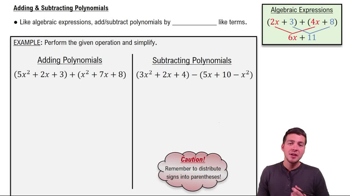
 03:34
03:34