Skip to main content
Introduction to Psychology
나의 코스
배우기
시험 준비
AI 튜터
학습 가이드
플래시카드
탐험해 보세요
앱을 사용해 보세요
나의 코스
배우기
시험 준비
AI 튜터
학습 가이드
플래시카드
탐험해 보세요
앱을 사용해 보세요
뒤로
Color Vision definitions
카드를 뒤집기 위해 탭할 수 있습니다.
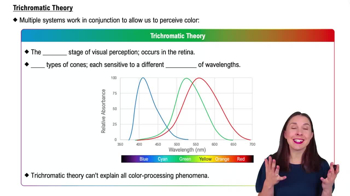
Trichromatic Theory
카드를 뒤집기 위해 탭할 수 있습니다.
👆
Trichromatic Theory
Explains initial color detection in the retina using three cone types sensitive to red, green, and blue wavelengths.
진행 상황 추적
컨트롤 버튼이 '내비게이션' 모드로 변경되었습니다.
1/15
관련 플래시카드
관련 실천
추천 영상
Color Vision quiz #1
Color Vision
10 용어
Color Vision
4. Sensation and Perception
7 문제점
주제
Nicole
Visual Anatomy
4. Sensation and Perception
7 문제점
주제
Nicole
4. Sensation and Perception
3 주제
9 문제점
장
Nicole
VideoThumbView.guidedCourse
01:48
Trichromatic Theory
865
views
13
rank
VideoThumbView.guidedCourse
03:19
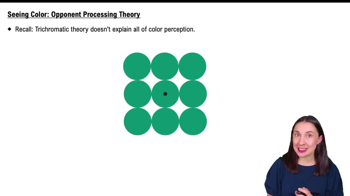
Opponent Process Theory
785
views
8
rank
VideoThumbView.guidedCourse
02:05
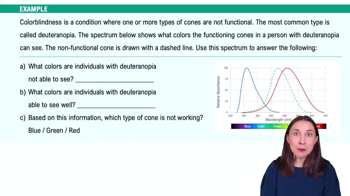
Color Vision Example 1
671
views
12
rank
이 집합의 용어 (15)
하이드의 정의
Trichromatic Theory
Explains initial color detection in the retina using three cone types sensitive to red, green, and blue wavelengths.
Opponent-Process Theory
Describes how color pairs are processed by opponent cells in the nervous system, accounting for phenomena like afterimages.
Cone
Photoreceptor in the retina specialized for detecting specific wavelength ranges, enabling color vision.
Retina
Light-sensitive layer at the back of the eye where initial color detection and visual processing begin.
Wavelength
Physical property of light that determines perceived color, with different cones sensitive to specific ranges.
Afterimage
Visual illusion where the complementary color appears after staring at a colored image and then looking away.
Opponent Cell
Neuron in the nervous system that responds to one color in a pair while being suppressed by its opposite.
Visual Cortex
Brain region that interprets neural signals from the eyes, constructing the perception of color.
Color Pair
Set of two colors, such as red-green or blue-yellow, processed in opposition by specific neural mechanisms.
Neural Impulse
Electrical signal transmitted by neurons, underlying the activation and suppression in color processing.
Sensation
Early stage of visual processing involving detection of light and color before interpretation by the brain.
Perception
Process by which the brain organizes and interprets sensory input, resulting in meaningful color experience.
Photoreceptor
Specialized cell in the eye that converts light into neural signals, essential for vision.
Pattern Recognition
Higher-level cognitive process where the brain identifies and interprets visual information beyond basic color.
Visual Field
Total area in which objects can be seen as the eyes focus on a central point.
 뒤로뒤로
뒤로뒤로
 01:48
01:48