Skip to main content
Introduction to Psychology
나의 코스
배우기
시험 준비
AI 튜터
학습 가이드
플래시카드
탐험해 보세요
앱을 사용해 보세요
나의 코스
배우기
시험 준비
AI 튜터
학습 가이드
플래시카드
탐험해 보세요
앱을 사용해 보세요
뒤로
Intro to Research Methods definitions
카드를 뒤집기 위해 탭할 수 있습니다.
Case Study
카드를 뒤집기 위해 탭할 수 있습니다.
👆
Case Study
An in-depth analysis of one individual or a small group, often focusing on unique situations to gather extensive qualitative data.
진행 상황 추적
컨트롤 버튼이 '내비게이션' 모드로 변경되었습니다.
1/15
관련 플래시카드
관련 실천
추천 영상
Intro to Research Methods quiz #1
Intro to Research Methods
19 용어
Intro to Research Methods
2. Psychology Research
7 문제점
주제
Nicole
Developmental Designs
2. Psychology Research
7 문제점
주제
Nicole
2. Psychology Research
5 주제
14 문제점
장
Nicole
VideoThumbView.guidedCourse
01:29
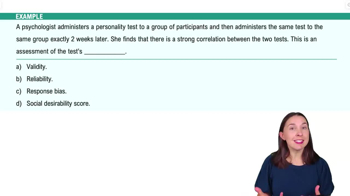
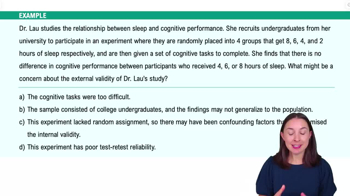
Intro to Research Methods Example 7
761
views
1
rank
VideoThumbView.guidedCourse
01:10
Intro to Research Methods Example 4
903
views
3
rank
VideoThumbView.guidedCourse
03:49
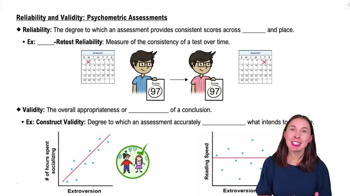
Reliability and Variability: Psychometric Assessments
809
views
4
rank
이 집합의 용어 (15)
하이드의 정의
Case Study
An in-depth analysis of one individual or a small group, often focusing on unique situations to gather extensive qualitative data.
Naturalistic Observation
A research approach involving unobtrusive monitoring of subjects in their typical environment to capture authentic behavior.
Laboratory Observation
A method where behavior is recorded in a controlled setting, allowing manipulation of variables and standardized tasks.
Psychometric Assessment
A measurement tool, such as a survey, interview, or standardized test, used to quantify psychological constructs.
Survey
A self-report instrument designed to efficiently collect data on attitudes, behaviors, or experiences from large groups.
Interview
A structured or unstructured conversation aimed at obtaining detailed, in-depth information on specific psychological topics.
Standardized Test
An assessment administered and scored uniformly, often requiring specialized training, to measure cognitive or psychological traits.
Reliability
The consistency of a measurement tool, reflected in stable results across time, settings, or different administrators.
Validity
The degree to which a tool or study accurately measures or reflects the intended construct or outcome.
Construct Validity
The extent to which a measure truly assesses the theoretical concept it is intended to capture, not unrelated variables.
Random Assignment
A procedure ensuring participants have equal chances of being placed in any group, increasing group equivalence.
Control Group
A set of participants not exposed to the independent variable, serving as a baseline for comparison in experiments.
Double-Blind Design
A study setup where neither participants nor researchers know group assignments, minimizing bias and expectancy effects.
Internal Validity
The level of confidence that observed effects are due to the independent variable, not confounding factors, within a study.
External Validity
The extent to which research findings can be generalized beyond the study sample to broader populations or settings.
 뒤로뒤로
뒤로뒤로
 01:29
01:29