Skip to main content
Introduction to Psychology
나의 코스
배우기
시험 준비
AI 튜터
학습 가이드
플래시카드
탐험해 보세요
앱을 사용해 보세요
나의 코스
배우기
시험 준비
AI 튜터
학습 가이드
플래시카드
탐험해 보세요
앱을 사용해 보세요
뒤로
Schizophrenia definitions
카드를 뒤집기 위해 탭할 수 있습니다.
Schizophrenia
카드를 뒤집기 위해 탭할 수 있습니다.
👆
Schizophrenia
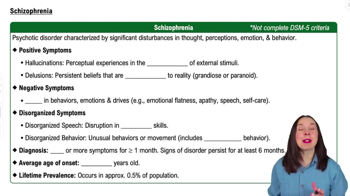
A psychotic disorder with disturbances in thought, perception, emotion, and behavior, often emerging between ages 18-35.
진행 상황 추적
컨트롤 버튼이 '내비게이션' 모드로 변경되었습니다.
1/15
관련 플래시카드
관련 실천
추천 영상
Schizophrenia quiz
Schizophrenia
15 용어
Schizophrenia
14. Psychological Disorders
7 문제점
주제
Depression
14. Psychological Disorders
7 문제점
주제
14. Psychological Disorders
5 주제
11 문제점
장
Nicole
VideoThumbView.guidedCourse
02:06
Example 1
268
views
VideoThumbView.guidedCourse
04:07
Risk Factors
279
views
VideoThumbView.guidedCourse
05:14
Schizophrenia
321
views
이 집합의 용어 (15)
하이드의 정의
Schizophrenia
A psychotic disorder with disturbances in thought, perception, emotion, and behavior, often emerging between ages 18-35.
Positive Symptoms
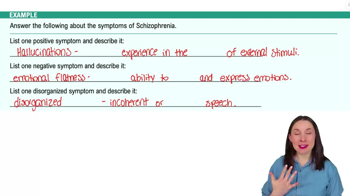
Features involving additions to normal experience, such as hallucinations or delusions, not typically present in healthy individuals.
Negative Symptoms
Features involving loss or reduction of normal behaviors or emotions, such as emotional flatness, apathy, or decreased speech.
Disorganized Symptoms
Manifestations including illogical speech or unusual movements, reflecting disruption in thought and behavior organization.
Hallucinations
Perceptual experiences occurring without external stimuli, most commonly auditory, but can involve any sense.
Delusions
Persistent beliefs contrary to reality, resistant to evidence, often involving themes of grandeur or persecution.
Grandiose Delusions
False beliefs of being an important figure or possessing exceptional abilities, despite evidence to the contrary.
Paranoid Delusions
False beliefs that one is being targeted or persecuted by individuals or groups, often without logical basis.
Disorganized Speech
Verbal output that lacks logical flow, often nonsensical or incoherent, making communication difficult to follow.
Disorganized Behavior
Unusual or repetitive actions, including unpredictable movements or catatonic episodes, disrupting daily functioning.
Catatonic Behavior
Episodes of immobility or unusual postures, where an individual may freeze and remain motionless for extended periods.
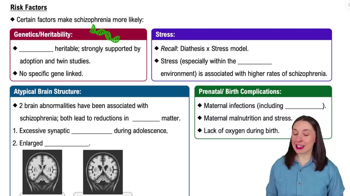
Genetic Predisposition
Increased likelihood of developing the disorder due to inherited factors, as supported by twin and adoption studies.
Synaptic Pruning
Adolescent brain process removing unused neurons; excessive occurrence is linked to reduced gray matter in the disorder.
Enlarged Ventricles
Expansion of brain cavities filled with cerebrospinal fluid, associated with loss of surrounding neural tissue.
Prenatal Complications
Adverse events during pregnancy or birth, such as maternal infection or lack of oxygen, increasing later risk for the disorder.
 뒤로뒤로
뒤로뒤로
 02:06
02:06