Skip to main content
Introduction to Psychology
나의 코스
배우기
시험 준비
AI 튜터
학습 가이드
플래시카드
탐험해 보세요
앱을 사용해 보세요
나의 코스
배우기
시험 준비
AI 튜터
학습 가이드
플래시카드
탐험해 보세요
앱을 사용해 보세요
뒤로
Summary of Important Brain Regions definitions
카드를 뒤집기 위해 탭할 수 있습니다.
Forebrain
카드를 뒤집기 위해 탭할 수 있습니다.
👆
Forebrain
Most evolutionarily advanced brain region, responsible for logic, rational thought, and complex cognitive functions.
진행 상황 추적
컨트롤 버튼이 '내비게이션' 모드로 변경되었습니다.
1/15
관련 플래시카드
관련 실천
추천 영상
Summary of Important Brain Regions quiz #1
Summary of Important Brain Regions
11 용어
Summary of Important Brain Regions
3. Biological Psychology
7 문제점
주제
Nicole
The Endocrine System
3. Biological Psychology
7 문제점
주제
Nicole
3. Biological Psychology - Part 1 of 2
5 주제
14 문제점
장
Nicole
3. Biological Psychology - Part 2 of 2
5 주제
12 문제점
장
Nicole
VideoThumbView.guidedCourse
07:55
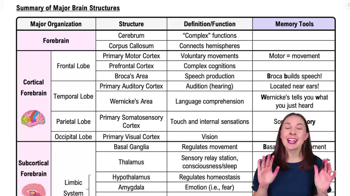
Summary of Major Brain Structures
840
views
21
rank
이 집합의 용어 (15)
하이드의 정의
Forebrain
Most evolutionarily advanced brain region, responsible for logic, rational thought, and complex cognitive functions.
Cerebrum
Largest brain part, divided into two hemispheres, governing higher-order thinking, memory, and voluntary actions.
Corpus Callosum
Thick bundle of nerve fibers connecting the left and right cerebral hemispheres, enabling communication between them.
Frontal Lobe
Front brain region involved in voluntary movement, executive functions, inhibitory control, and speech production.
Primary Motor Cortex
Area within the frontal lobe that initiates and controls voluntary muscle movements.
Broca's Area
Region near the motor cortex essential for producing spoken language and coordinating speech muscles.
Temporal Lobe
Side brain region near the ears, crucial for processing auditory information and language comprehension.
Wernicke's Area
Temporal lobe region vital for understanding spoken and written language.
Parietal Lobe
Upper middle brain region processing touch, spatial awareness, and internal body sensations.
Primary Somatosensory Cortex
Parietal lobe area receiving and interpreting sensory information from the body, such as touch and proprioception.
Occipital Lobe
Rear brain region dedicated to visual processing and interpretation.
Basal Ganglia
Subcortical structures regulating movement initiation, inhibition, and coordination with the motor cortex.
Thalamus
Central relay station for sensory signals, also involved in consciousness and sleep regulation.
Limbic System
Group of structures managing emotion, memory, and homeostasis, including the hypothalamus, amygdala, and hippocampus.
Cerebellum
Hindbrain structure resembling a small brain, responsible for coordination, balance, and precise motor control.
 뒤로뒤로
뒤로뒤로
 07:55
07:55