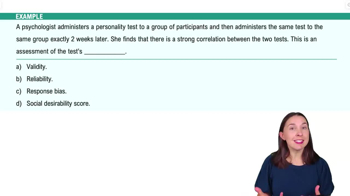
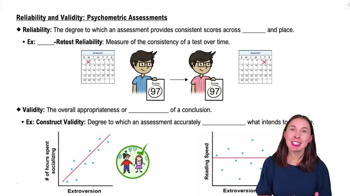
Why are experiments particularly useful for making causal claims?
Experiments isolate the independent variable and control for confounding variables, and the independent variable always precedes the dependent variable.
What is a key feature of a double-blind experiment?
Neither the researcher nor the participant knows which group the participant is in.
What does internal validity indicate in experimental design?
How well the study controls for confounding factors.
What does external validity indicate in experimental design?
The extent to which findings can be generalized to the population.
Name three ways to strengthen internal validity.
1. Random assignment 2. Using reliable psychometric assessments 3. Making an experiment double-blind.
Name two ways to strengthen external validity.
1. Random sampling 2. Study conditions that reflect the real world.
What is a limitation of lab experiments studying complex real-world phenomena?
They may have low external validity because lab conditions can't fully reflect real-world experiences.
Which practice improves internal validity?
Random assignment improves internal validity by controlling confounding variables.
What are the two main types of developmental research designs?
1. Longitudinal (same individuals over time) 2. Cross-sectional (different age groups at one time).
What is a key strength of longitudinal designs?
They capture individual development and establish temporal precedence among variables.
What is a key limitation of longitudinal designs?
They are time-consuming, expensive, and suffer from attrition (dropout).
What is a key strength of cross-sectional designs?
They are faster and cheaper to conduct and do not lose participants due to attrition.
What is a limitation of cross-sectional designs?
They cannot capture individual development or establish temporal precedence.
What are descriptive statistics?
Statistics that summarize data, including measures of central tendency and variability.
What are measures of central tendency?
Values that represent the most typical or common data points: mean, median, and mode.
When is the median preferred over the mean?
When the dataset has outliers that skew the mean.
What does variability measure in data?
How spread out the data points are around the mean.
What is the range in descriptive statistics?
The difference between the highest and lowest values in the dataset.
What does standard deviation indicate?
The average distance each data point is from the mean.
What does a correlation coefficient (r) measure?
The direction and strength of a relationship between two variables.
What does a negative correlation indicate?
Variables move in opposite directions.
What does a positive correlation indicate?
Variables move in the same direction.
Why does correlation not imply causation?
Because of lack of temporal precedence and the third-variable problem where an unmeasured variable influences both.
What is the third-variable problem?
An unmeasured variable that influences both variables being studied, causing a spurious correlation.
What are inferential statistics used for?
To determine how statistically significant study results are and the probability results occurred by chance.
What p-value threshold is commonly used to indicate statistical significance?
A p-value less than .05 indicates statistical significance.
When must you include a reference in APA format?
When you paraphrase or discuss another's work or state something as a fact.
What information is included in an APA in-text citation?
The author's last name and year of publication.
How do you shorten an in-text citation with three or more authors in APA?
Use the first author's last name followed by et al.
 뒤로
뒤로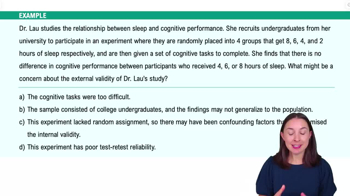
 01:29
01:29